
What Is Nursing Home Power of Attorney?
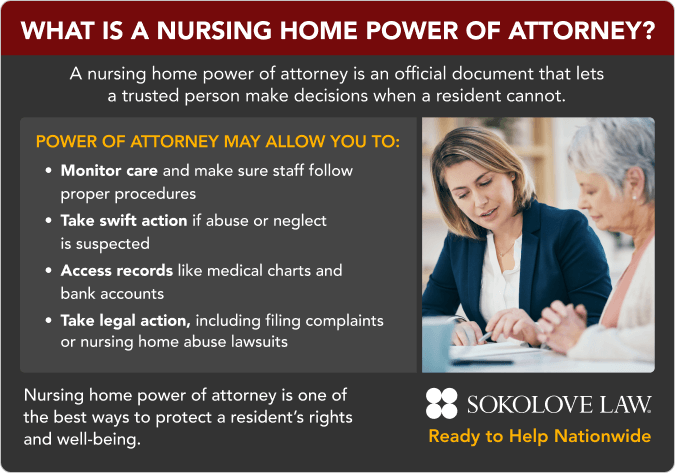
Nursing home power of attorney is a legal document that allows a resident's loved one to make decisions on their behalf. This may involve weighing in on medical care, finances, or both, depending on the type of POA.
It’s strongly recommended to have a POA in place before admission to a nursing home or while the resident is still capable of making decisions. Many facilities encourage families to complete a POA as part of the intake process.
More than 50% of adults over 70 have a power of attorney, compared to less than 10% under 40. Most name a spouse or close family member to make decisions if they can’t.
A POA can be useful at any age, but it becomes essential when long-term care is needed. It gives a trusted person the right to oversee care, make decisions, and take legal action for nursing home abuse to protect the resident’s safety and dignity.
At Sokolove Law, our nursing home abuse lawyers have over 45 years of experience helping families secure the justice they deserve. Contact our team now.
Since 1979, our nursing home abuse lawyers have secured over $337 Million for clients nationwide.
Get a Free Case Review
How a Power of Attorney Protects Nursing Home Residents
In a nursing home, decisions about care, safety, and finances often need to happen quickly. A power of attorney ensures a trusted person has clear legal authority to make these important decisions.
With a valid nursing home power of attorney in place, you can:
- Ensure continuity of care during emergencies
- Make timely medical and financial decisions that protect a resident’s well-being
- Move your loved one to a new facility if they’re not receiving adequate care
- Take legal action if nursing home neglect or abuse is suspected

“A nursing home lawsuit can be filed by the resident, a legal guardian, or a family member with power of attorney.”
– Ricky LeBlanc, Managing Attorney at Sokolove Law
A nursing home POA gives families the legal authority to protect their loved one. However, even without one, you can still file a nursing home complaint to help if you believe abuse or neglect may have occurred.
Types of Power of Attorney for Nursing Home Residents
Families may choose from several types of nursing home power of attorney depending on their loved one’s needs and the level of care they require. Each type gives the appointed agent different authority.
A nursing home POA may be made durable, meaning it remains valid even if the resident becomes incapacitated — a key safeguard in long-term care, where nearly 50% of residents have Alzheimer's or another form of dementia.
It’s important to understand which type of nursing home POA you have and what it allows you to do to ensure your loved one receives the support they deserve.
General Nursing Home Power of Attorney
A general nursing home power of attorney gives broad authority to handle a resident’s legal, financial, and personal affairs.
This can include:
- Managing property, pensions, or other assets to fund care
- Paying nursing home bills or managing income deposits
- Signing legal or insurance documents on the resident’s behalf
Because it covers many areas, a general nursing home POA is often best suited for families who want continuous oversight of both medical and financial matters.
Financial Nursing Home Power of Attorney
A financial POA focuses solely on money and property. This authority helps prevent missed payments or financial abuse — a serious concern, as 1 in 10 older adults experience financial exploitation.
An agent with financial nursing home POA can:
- Manage Social Security, VA, or retirement benefits
- Pay nursing home expenses and other medical bills
- Protect savings, property, or investments from misuse
This type of POA can help families maintain control of a loved one’s finances and ensure funds are used solely for their care and comfort.
Health Care Nursing Home Power of Attorney
A health care nursing home power of attorney allows a trusted person to make medical decisions when the resident can’t.
With many nursing home residents requiring help making medical choices, this role is vital for ensuring treatment aligns with your loved one’s wishes.
A health care power of attorney for a nursing home resident may:
- Access medical records to monitor ongoing care
- Approve or refuse medical treatments
- Choose doctors or specialists
- Make decisions about life-sustaining care or transfers to hospitals
This form of POA ensures that someone familiar with the resident’s values can advocate for their best interests when they’re unable to do so.
Limited or Special Nursing Home Power of Attorney
A limited or special power of attorney in a nursing home grants authority for only a specific task or time period.
In a nursing home setting, this might include:
- Handling one financial transaction
- Managing a property sale to pay for care
- Signing admission paperwork
This short-term option can be helpful when immediate action is needed, but a full POA hasn’t been set up yet. However, once the task is complete, the agent’s authority ends.
What a Nursing Home Power of Attorney Can’t Do
A nursing home power of attorney must follow state laws and the limits outlined in the legal document. POAs give important decision-making authority, but that power isn’t unlimited.
In general, a nursing home power of attorney cannot:
- Act outside the scope of authority granted in the POA document
- Change or create a will on behalf of the resident
- Make decisions that are not in the resident's best interest
- Override the resident’s wishes while they still have the capacity to make their own decisions
- Transfer their authority to another person
- Use the resident’s money or property for personal gain
Power of attorney ends after a nursing home resident’s death. POAs can’t continue to act on behalf of a resident after their passing, unless the same person is named as executor of their estate.
Setting Up a Power of Attorney for Nursing Home Residents
When a loved one enters a nursing home, families naturally worry about their safety, care, and dignity. Sadly, abuse and neglect in long-term care remain common.
A nursing home power of attorney is one of the most effective ways to protect your loved one’s rights and ensure consistent care.
Learn about tips for setting up a nursing home POA:
- Choose a trusted agent: Select someone reliable, honest, and fully aware of your loved one’s wishes.
- Decide on the type: A medical POA covers health care decisions, while a financial POA manages money and property. A durable POA stays valid even if your loved one becomes incapacitated.
- Set it up early: Establish the POA before your loved one’s health declines to avoid court delays or conflicts over guardianship.
- Follow state law: Make sure the document includes required signatures, witnesses, or notarization so it is legally binding.
- Share and communicate: Give copies to nursing home staff, doctors, and family members to keep everyone informed and prevent confusion.
It’s important to get a valid POA in place as soon as possible. If your loved one has been abused or neglected in a nursing home, you could lose the right to pursue justice on their behalf if the filing deadline known as the statute of limitations expires.
Taking Legal Action with Nursing Home Power of Attorney
Power of attorney and nursing home care often go hand in hand when a resident cannot make decisions for themselves. A valid POA gives families the legal right to step in, protect their loved one’s safety, and take action if neglect or abuse occurs.
About 44% of older adults in long-term care facilities experience some form of abuse, yet only around 7% of cases are ever reported, according to the National Institutes of Health.
With this authority, an agent can communicate directly with nursing home staff, access care records, and work with a nursing home attorney to hold the facility accountable for harm.

“We have a national network of attorneys who focus exclusively on nursing home abuse and neglect. The people we work with understand what families go through — from cases of dehydration to choking deaths. We’ve seen every one of these problems.”
– Jim Sokolove, Firm Founder (Retired 2013)
If a resident is experiencing abuse or neglect, the agent may also have the right to pursue a nursing home lawsuit settlement. This money can help with medical bills, the cost of transferring a loved one to a new facility, and other expenses.
Filing a nursing home abuse lawsuit can bring accountability and justice to those who trusted a facility to provide proper care. By establishing a nursing home power of attorney, families have the ability to protect their loved one before a dangerous situation becomes a tragedy.
Get Help Filing a Nursing Home Lawsuit
At Sokolove Law, our nursing home abuse lawyers help families in all 50 states take legal action when nursing homes cause harm or a heartbreaking loss.
With a valid nursing home power of attorney, you can act on your loved one’s behalf, access records, and file a lawsuit for abuse or neglect.
Here’s why families put their trust in our nursing home law firm:
- No upfront costs or hourly fees to work with our team
- Over 45 years of experience fighting for those harmed in long-term care facilities
- More than $337 Million recovered for victims of nursing home abuse and neglect
If your loved one was harmed in a care facility, we're prepared to guide you through the legal process and fight for the compensation you deserve.
Call (800) 995-1212 now or fill out our contact form to get started with a free, no-obligation case review.
Power of Attorney & Nursing Homes FAQs
Who can be named as a power of attorney for a nursing home resident?
Any adult of sound mind can serve as a nursing home power of attorney (POA). Families often choose a trusted relative or close friend to make care and financial decisions if the resident cannot. The POA’s role includes protecting the resident’s well-being and taking action if signs of nursing home neglect or abuse occur.
If your loved one’s rights have been violated or their safety is at risk, our team may be able to help you take the next step.
Contact Sokolove Law now for a free, no-obligation case review
Can power of attorney force someone into a nursing home?
No. A power of attorney cannot force someone into a nursing home if they are still capable of making their own decisions. A health care agent may only arrange placement when the person has lost decision-making capacity and the POA document specifically grants that authority.
If families disagree about a loved one’s care or safety, they can reach out to a long-term care ombudsman for help. The ombudsman can talk with the nursing home and family, help resolve problems, and make sure the resident’s rights are respected.
Can a nursing home have power of attorney?
No. A nursing home, including its owners, administrators, and employees, cannot hold power of attorney for a resident in most states unless they are close relatives. This rule helps prevent elder abuse, neglect, or financial exploitation.
Can a nursing home override a power of attorney?
No. Nursing homes and long-term care facilities cannot override a valid power of attorney. Only the resident, if they still have decision-making ability, or a court can change or revoke it. A facility may question or refuse a POA that looks invalid, incomplete, or unclear under state law.
If a facility is ignoring your authority or blocking you from taking action, our team may be able to help. Call (800) 995-1212 now for free.
What’s the difference between nursing home power of attorney and guardianship?
A nursing home power of attorney is a voluntary legal document created by someone who can still make their own decisions. It gives a trusted person the authority to act on their behalf.
Guardianship, also called conservatorship, is ordered by a court when a person becomes unable to manage their affairs and no valid POA exists. Guardianship is more limited, more expensive, and often takes longer to put in place.
How can I prevent someone from abusing their power of attorney?
The best protection is to choose a trustworthy agent and set clear limits in the nursing home power of attorney document. Additional safeguards include requiring two signatures for major financial actions, scheduling regular reviews, and sharing records with another family member for oversight.
If you suspect power of attorney abuse or financial exploitation in a nursing home, contact a nursing home attorney or your local long-term care ombudsman to report it and get help protecting your loved one.
Do nursing homes require power of attorney?
Nursing homes and assisted living facilities usually do not require a power of attorney, but having one helps ensure care and financial matters are handled smoothly. A POA lets a trusted person make decisions if the resident becomes unable to.
Without one, families may face delays in treatment or billing, and serious issues like nursing home abuse or neglect can be harder to address quickly.
Is power of attorney responsible for nursing home bills?
Someone with power of attorney is not personally responsible for nursing home bills. Their role is to manage the resident’s finances using the resident’s own funds.
Financial responsibility stays with the resident or their estate unless the agent signs a separate agreement accepting that debt. Federal law prohibits facilities from requiring third-party payment as a condition of care.