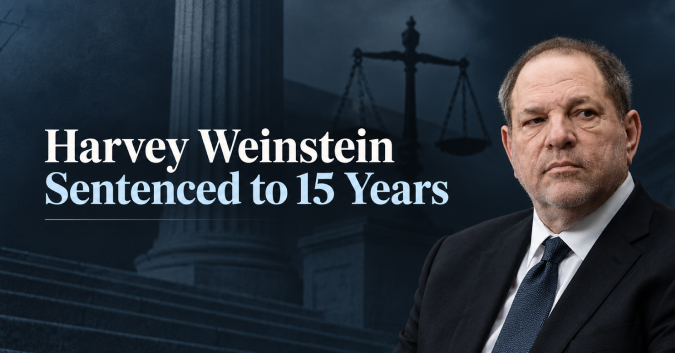
On September 23, Harvey Weinstein was sentenced to 15 years in prison following his retrial in New York. Weinstein, once a powerful Hollywood producer, has been accused of sexual assault and misconduct by more than 80 women.
The allegations against Weinstein helped ignite the #MeToo movement and brought widespread attention to how powerful individuals can use their positions to sexually abuse and exploit others. His criminal cases have since involved convictions, overturned verdicts, mistrials, and retrials.
For survivors of sexual abuse by powerful individuals or institutions, Weinstein's case also highlights an important distinction: A civil claim doesn't have to wait for a criminal case to be resolved.
At Sokolove Law, our sexual abuse attorneys help survivors understand their legal options, independent of what happens in criminal court.
What Happened at Harvey Weinstein's Prison Sentencing in 2026?
A Manhattan judge sentenced Weinstein to 15 years in prison, followed by 5 years of post-release supervision, and ordered him to register as a sex offender.
The sentence resolves a case that has now produced 2 separate convictions, 2 separate sentences, and years of repeated hearings.
Weinstein was convicted in June 2025 for assaulting Miriam Haley, a former "Project Runway" production assistant, in his New York apartment in 2006. The same jury acquitted him of a separate charge involving former model Kaja Sokola and deadlocked on a rape charge involving Jessica Mann.
A second trial on the Mann charge also ended in a hung jury, and in June 2026, Manhattan prosecutors announced they would not pursue a fourth trial.
Weinstein's defense argued for a shorter sentence, citing his declining health. Prosecutors sought a longer term. The judge's 15-year sentence fell between the two requests.
A Case That Keeps Reopening: Weinstein's Legal Timeline
Weinstein's case illustrates how a single set of allegations can generate years of separate legal proceedings, each one requiring survivors to revisit their testimony.
Key dates in the Harvey Weinstein sentence include:
- 2017: More than 80 women publicly accuse Weinstein of sexual assault or harassment, sparking the broader #MeToo movement.
- 2020: A New York jury convicts Weinstein of 3rd-degree rape (Mann) and 1st-degree criminal sexual act (Haley). He's sentenced to 23 years.
- 2022: A Los Angeles jury convicts Weinstein of rape and 2 counts of sexual assault involving actor Evgeniya Chernyshova. He's sentenced to 16 years in February 2023.
- 2024: New York's highest court overturns the 2020 conviction, ruling Weinstein did not receive a fair trial, and orders a new trial.
- 2025: A second New York jury convicts Weinstein on the Haley count, acquits him on the Sokola count, and deadlocks on the Mann count. A retrial on the Mann charge also ends in a hung jury.
- June 2026: Prosecutors decline to pursue a fourth trial on the Mann charge.
September 2026: Weinstein is resentenced to 15 years in New York. A resentencing hearing in California, to determine whether his sentences run concurrently or consecutively, has not yet been scheduled.
Nine years after the first public accusations, Weinstein's legal proceedings are still not fully resolved.
As a result, nearly a decade of trials, appeals, retrials, and sentencing proceedings continues to shape how much time Weinstein may ultimately spend in prison.
Why Survivors Say the Legal Process Can Be Difficult — and What Helps
Harvey Weinstein's sentencing shows just how long a high-profile criminal case can stretch on, with appeals, retrials, and resentencings that ask survivors to keep participating long after they thought their testimony was finished.
It's important to note that Weinstein's case is not typical. Most survivors who come forward do not face anything close to this level of legal back-and-forth. However, what the case does show is how much the right support matters.
Survivors who have a sexual abuse attorney like the ones at Sokolove Law guiding them through each stage, and who know what to expect before a hearing happens, are far better equipped to handle the legal process than survivors navigating it alone.
Additionally, coming forward is what makes accountability possible in the first place — Weinstein's original conviction, however many times it's been revisited, would never have happened without it.
“There is no prison sentence long enough to erase the damage. He deserves to experience the same shame, humiliation and fear as I did.”
– Harvey Weinstein Sexual Abuse Survivor
Civil Claims Don't Have to Wait on a Criminal Case
One of the most important things survivors of sexual abuse often don't realize is that criminal and civil cases run on entirely separate tracks. A criminal case can be appealed, retried, or resentenced without affecting a survivor's ability to pursue a civil claim.
Civil lawsuits use a different, lower standard of proof than criminal cases, and a survivor doesn't need a criminal conviction, or even criminal charges, to bring one.
Some other ways survivors' legal options don't depend on the criminal process:
- Many states have passed statute of limitations revival laws in recent years, opening temporary windows for survivors to file civil claims for abuse that happened long ago, regardless of whether any criminal case was ever filed.
- A civil claim can proceed against an institution, like an employer, a school, or a religious organization, even when no individual is ever criminally charged, if that institution knew about abuse and failed to act.
- Civil settlements and judgments are not contingent on a criminal sentence standing. A criminal conviction being overturned on appeal doesn't undo a separate civil resolution.
If you're waiting to see how a criminal case turns out before deciding whether to pursue your own legal options, it's worth knowing that you likely don't have to wait at all.
Other Institutions and Individuals Held Accountable for Sexual Abuse
Weinstein's case is part of a broader pattern of survivors using the civil justice system to hold powerful individuals and institutions accountable, sometimes independent of, or in addition to, criminal proceedings.
Recent cases include:
- $100 Million Ohio State settlement for survivors of a former team physician, bringing the university's total payouts to more than $161 Million
- $72.5 Million Bank of America settlement for survivors trafficked by Jeffrey Epstein, one of multiple banks to reach a settlement without admitting liability
- $59 Million Bill Cosby civil verdict, secured by a survivor years after his criminal conviction was overturned on appeal
Each of these cases shows the same pattern: civil accountability that didn't depend on a single, final criminal outcome to move forward.
Sokolove Law: Fighting for Survivors of Sexual Abuse
No one should have to wait years, or watch a criminal case unravel and restart, to find out whether they have a path to justice.
At Sokolove Law, we've spent over 45 years helping survivors of sexual abuse pursue civil claims against the individuals and institutions responsible, regardless of what happens in a parallel criminal case.
There are no upfront costs and no hourly fees to work with our team. We only get paid if you do.
Call (800) 995-1212 right now or contact us online for a free, no-obligation case review. We're standing by to answer your questions.