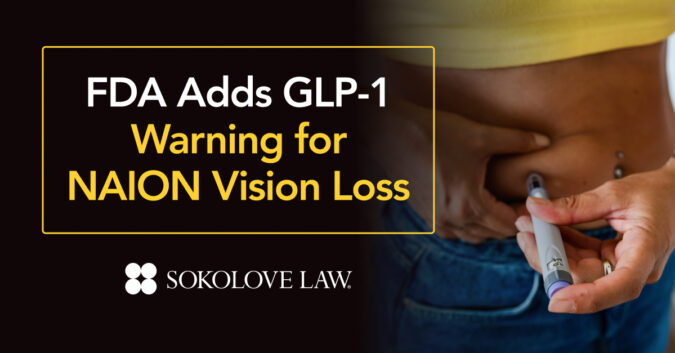
On November 9, the U.S. Food and Drug Administration (FDA) announced that it is requiring every GLP-1 receptor agonist medication, including Ozempic®, Mounjaro®, and Wegovy®, to add a new warning about the risk of a serious eye condition.
The condition is called non-arteritic anterior ischemic optic neuropathy (NAION) and can cause sudden, permanent vision loss in one eye.
An FDA review of 126 clinical trials found that patients taking GLP-1 drugs had a roughly 70% higher rate of NAION than patients who weren't taking the drugs.
However, the FDA is only now requiring all GLP-1 RA manufacturers to add NAION risk information to the Warnings and Precautions section of their drug labels.
This new FDA warning on Ozempic and other GLP-1 drugs comes after hundreds of patients have already filed NAION vision loss lawsuits, alleging they were not adequately warned of this risk.
If you or a loved one experienced sudden vision loss after taking a GLP-1 medication, Sokolove Law may be able to help. Learn more about your options with a free case review.
What Does the New GLP-1 Warning Mean?
The FDA's decision to add a warning about nonarteritic anterior ischemic optic neuropathy (NAION) to GLP-1 medication labels formally recognizes a potential link between these drugs and a serious eye condition that can cause sudden, permanent vision loss.
The update is significant for millions of people who take medications like Ozempic and Wegovy, as well as those who have already experienced vision problems after using them.
It raises questions about whether drug manufacturers adequately investigated, communicated, and warned consumers about potential vision complications before the label changes.
Here's what the new GLP-1 warnings could mean:
- For current and former patients: The updated labels give patients and their doctors formal notice of the NAION risk. People taking GLP-1 medications can discuss potential vision symptoms, treatment if affected, and whether continued use is appropriate with their health care providers.
- For people who experienced vision loss: Those who developed NAION or other serious vision complications after taking a GLP-1 medication may be able to take legal action, pursuing compensation for their injury.
- For ongoing lawsuits: The FDA's review of clinical trials, real-world evidence, and published research could become relevant evidence in litigation. These findings may help plaintiffs investigate when manufacturers became aware of the potential risks and whether earlier warnings were warranted.
- For drug manufacturers: The label changes put additional attention on the responsibility to communicate known safety risks to doctors and patients.
The FDA's data review could become important evidence in GLP-1 vision loss lawsuits, helping people who suffered NAION or other vision injuries show that manufacturers knew or should have known about the risks sooner.
Is NAION an Ozempic Black Box Warning?
No. As of November 2026, the FDA has not issued an Ozempic black box warning, the agency's most serious labeling designation, for GLP-1 drugs and NAION.
Instead, the FDA is requiring manufacturers to add information about NAION risk to the Warnings and Precautions section of their labels, a less severe but still significant classification.
The agency has directed health care providers to counsel patients on NAION symptoms and to consider discontinuing a GLP-1 medication if a patient develops the condition.
Why Didn't GLP-1 Drugs Already Warn About Vision Loss?
Concerns about a link between GLP-1 drugs and vision loss aren't new. In July 2024, researchers published a study in JAMA Ophthalmology finding an association between semaglutide (the active ingredient in Ozempic and Wegovy) and NAION.
The FDA said it identified limitations in that study, but determined the signal warranted a deeper look. That review included an analysis of 126 clinical trials involving more than 134,000 patients, a study using health insurance data, and a review of published medical research.
Based on the evidence, the FDA concluded that GLP-1 drugs may increase the risk of NAION.
"NAION cases have been reported for all currently marketed GLP-1 RA products," the FDA noted in its safety communication.
The GLP-1 FDA warning comes more than 2 years after the initial study raised concerns.
The timing is particularly significant for ongoing GLP-1 vision loss lawsuits, in which patients allege that manufacturers knew or should have known about the risk of NAION and failed to adequately warn patients and doctors.
Hundreds of GLP-1 Vision Loss Lawsuits Already Filed
Even before the FDA Ozempic warning, nearly 300 GLP-1 NAION lawsuits were already pending in a federal multidistrict litigation, consolidating claims from patients who say they developed vision loss after taking the medications.
GLP-1 drugs named in current vision loss lawsuits include:
- Ozempic and Rybelsus® (semaglutide)
- Wegovy (semaglutide)
- Mounjaro and Zepbound® (tirzepatide)
- Trulicity® (dulaglutide)
- Saxenda® and Victoza® (liraglutide)
Deadlines to file a GLP-1 vision loss lawsuit vary by state, so it's important to act quickly if you believe you were affected.
Get Help Filing a GLP-1 Vision Loss Lawsuit
When you start a new medication, you should be able to trust that you've been told about its serious risks. For years, patients taking GLP-1 drugs for diabetes or weight loss weren't given that information.
At Sokolove Law, our dangerous drug lawyers are committed to holding pharmaceutical manufacturers accountable when they fail to warn patients about known risks.
With over 45 years of experience, Sokolove Law has recovered more than $1.6 Billion total for injured clients across the country.
Call (800) 995-1212 right now or fill out our online form for a free case review case review now. It costs nothing to speak with our team and learn more about your legal options.