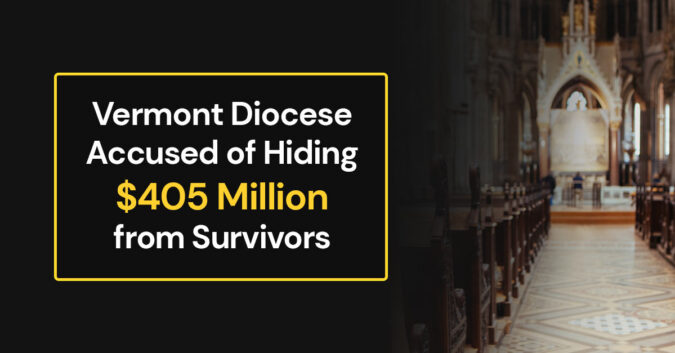
A creditors committee alleges the Roman Catholic Diocese of Burlington used parish trusts to keep hundreds of millions of dollars in real estate out of reach of clergy sexual abuse survivors.
The committee appointed to represent survivors and other creditors in the Diocese of Burlington bankruptcy filed a lawsuit alleging the diocese moved $405 Million in real estate into parish trusts to shield those assets from sexual abuse survivors seeking compensation.
The lawsuit centers on a legal question that could decide how much survivors ultimately recover: Are Vermont's parishes truly independent from the diocese, or are they just operating divisions whose assets should be part of the bankruptcy estate?
"The parishes aren't separate, and the trusts aren't valid. It's one diocese, hiding its own money from the people it harmed. We now can prove that in court."
– Diocese of Burlington Abuse Lawyer
At Sokolove Law, we believe survivors deserve full accountability — not legal maneuvering designed to keep them from the compensation they're owed. For decades, we've helped survivors of clergy sexual abuse take on powerful religious institutions.
Behind the Vermont Diocese Bankruptcy Case
In September 2024, the Diocese of Burlington filed for Chapter 11 bankruptcy protection after being named in 31 clergy sexual abuse lawsuits.
Survivors and other creditors expected diocesan and parish property to be part of the pool used to fund compensation. Instead, the diocese moved a large share of valuable real estate out of reach nearly two decades earlier.
The diocese created parish trusts in 2006, covering 128 parishes across Vermont. The committee claims the diocese still holds title to each trust, and that every trust agreement named the bishop as trustee, giving him the authority to administer, control, and even terminate the trust.
The complaint also points to a letter then-Bishop Salvatore Matano wrote around the time the trusts were created:
"In such litigious times, it would be a gross act of mismanagement if I did not do everything possible to protect our parishes and the interests of the faithful from unbridled, unjust and terribly unreasonable assault."
The committee cites that language as evidence the trust structure was built in anticipation of lawsuits, not simply routine estate planning.
The complaint also cites testimony from Bishop John J. McDermott that the trusts came out of "concern over parish properties being at risk in light of pending lawsuits," and notes that 19 sexual abuse claims were already pending against the diocese in 2007.
A recent procedural ruling allowed the creditors committee to move forward with their claims, clearing the way for a court to decide whether the 2006 transfers can be reversed.
What the Diocese of Burlington Abuse Lawsuits Allege
The dispute over the Diocese of Burlington's assets comes after decades of sexual abuse allegations involving Catholic clergy in Vermont.
As more survivors came forward and pursued legal action, the diocese paid millions of dollars to resolve claims before ultimately filing for bankruptcy.
Key developments in Diocese of Burlington abuse lawsuits include:
- More than $30 Million paid to survivors: Since 2006, the Diocese of Burlington has reportedly paid more than $30 Million to settle clergy sexual abuse allegations.
- 40 accused priests identified: In 2019, the diocese publicly released the names of 40 priests accused of sexually abusing children in Vermont, with allegations dating back to the 1950s.
- Vermont eliminated the statute of limitations: In 2019, state lawmakers removed the statute of limitations for civil claims involving childhood sexual abuse, allowing survivors to pursue claims involving abuse that occurred decades earlier.
- New lawsuits followed: The change in Vermont law led to additional sexual abuse lawsuits against the diocese and increased the number of survivors seeking accountability and compensation.
- Bankruptcy could limit future claims: The bankruptcy process is expected to establish a bar date for filing claims against the diocese. Survivors who don't file before that deadline may lose the opportunity to seek compensation through the bankruptcy.
Against that history, the fight over whether roughly $405 Million in parish real estate should be available to creditors could have significant consequences for how much money is ultimately available to compensate survivors.
Why This Matters for Vermont Catholic Diocese Sexual Abuse Survivors?
For survivors, the dispute over the Diocese of Burlington’s parish properties is ultimately about how much money may be available for compensation.
The creditors committee's effort to bring $405 Million in parish real estate into the compensation fund could significantly increase the pool of assets available to resolve sexual abuse claims.
Here’s what this means for Vermont Catholic Diocese sexual abuse survivors:
- A diocese's total assets are often larger than what's reported. Property tied up in parish trusts, subsidiaries, or other legal structures may not show up in initial bankruptcy filings.
- You don't have to take the diocese's word for what's "off limits." Creditors committees, sexual abuse attorneys, and courts can challenge whether transfers like these were legitimate.
- Old records can still matter. Letters, testimony, and internal communications from years or decades ago, like the ones cited in this case, can become key evidence in determining whether assets should be recoverable.
- Bankruptcy timelines move slowly, but claims deadlines don't wait. If you haven't filed a claim in a diocesan bankruptcy, or aren't sure whether you still can, it's worth finding out before a deadline passes.
Sorting through asset structures, past transfers, and what's legally recoverable is exactly what your legal team is for. Our sexual abuse attorneys will pursue every available avenue to hold the Vermont Catholic Diocese accountable and seek justice on your behalf.
These factors don't guarantee that additional assets will become available to survivors. The court will ultimately determine which assets legally belong in the bankruptcy estate and whether any past transfers can be challenged or reversed.
A Pattern of Dioceses Shielding Assets in Bankruptcy
The Burlington dispute raises a larger issue that has surfaced in Catholic Church bankruptcies across the country: whether dioceses have moved or structured assets in ways that keep substantial wealth outside the reach of survivors.
Recent diocesan bankruptcy resolutions include:
- $395 Million: Archdiocese of San Francisco, California, covering roughly 530 survivors (2026)
- $246 Million: Diocese of Rochester, New York, covering more than 450 survivors (2025)
- $180 Million: Diocese of Camden, New Jersey, covering roughly 300 survivors, including an earlier $87.5 Million settlement (2025)
- $323 Million: Diocese of Rockville Centre, New York, covering approximately 600 survivors (2024)
- $880 Million: Archdiocese of Los Angeles, California, covering more than 1,300 survivors (2024)
Georgetown University's Center for Applied Research in the Apostolate has estimated that U.S. Catholic dioceses and religious orders have spent more than $5 Billion on clergy sexual abuse claims over the past two decades.
What's different about the Burlington case is that it isn't a sexual abuse settlement — it's a fight over whether hundreds of millions of dollars should even be counted as part of what's available to survivors in the first place.
What Diocese of Burlington Abuse Survivors Can Do Now
If you were abused by clergy connected to the Diocese of Burlington, or by clergy in any diocese now in bankruptcy, this case is a reminder that what a diocese initially reports as assets isn't always the full picture.
Regardless of how this particular fight over parish assets is resolved, there are steps worth taking now:
- Pay attention to claims deadlines. The bankruptcy court may establish deadlines for survivors to file sexual abuse claims, including claims involving abuse that happened decades ago.
- Don't assume it's too late to file. Vermont eliminated the statute of limitations for civil childhood sexual abuse claims, but separate deadlines imposed through the bankruptcy process may still apply.
- Keep any records related to the abuse. Documents, correspondence, photographs, school or parish records, and other information may help establish when and where abuse occurred.
- Consider speaking with a sexual abuse attorney. An attorney can help determine whether you may still be eligible to file a claim and explain how the bankruptcy could affect your legal options.
Acting on these now can make a real difference once the court decides how much of the $405 Million is actually available.
Sokolove Law: Fighting for Survivors of Clergy Sexual Abuse
At Sokolove Law, we've spent over 45 years fighting for survivors of sexual abuse and other serious harm, including survivors abused by clergy and other trusted authority figures.
Our experienced clergy sexual abuse attorneys know how to navigate complex bankruptcy and institutional cases. We're here to help you understand your legal options and find a path forward toward healing.
We've secured more than $10.6 Billion total for clients harmed through no fault of their own, including survivors of sexual abuse.
There are no upfront costs and no hourly fees to work with our team. We only get paid if you do.
Call (800) 995-1212 now or fill out our online form to get a free, confidential case review.