Nursing home residents are among the most vulnerable people in the country. Many depend on staff for everything from meals to medication to basic hygiene — and not all of them can speak up if that care turns into harm.
That combination is part of why nursing home abuse so often goes unreported, and why families are frequently the ones who first notice something is wrong.
With more than 45 years handling nursing home abuse and neglect cases, Sokolove Law has recovered over $332 Million total for victims and their families nationwide.
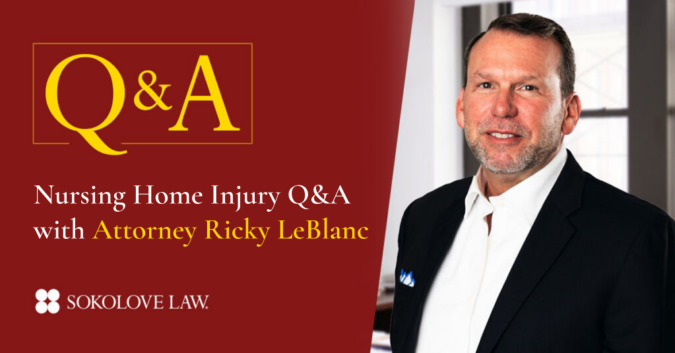
Ricky LeBlanc, Managing Attorney at Sokolove Law, has been fighting for victims of nursing home abuse and neglect since 1991. He sat down to answer the questions families ask most.
Get a Free Nursing Home Case Review
Q: What is considered nursing home abuse or neglect?
A. Nursing home injuries usually fall into two buckets: intentional harm or negligence. Intentional harm is a situation where staff has intentionally caused injury. They could be too forceful in restraining your loved one or in assisting your loved one.
Intentional harm could be emotional. Staff could be dehumanizing, insulting, or putting fear into your loved one. And it's also financial. They could be literally stealing from your family.
On the other side of the coin is negligent behavior, and that is when staff has either failed to do something or has done something negligently. Generally, it's failed.
And by that, I mean that your loved one may develop bedsores. Why? Because the attendants have failed to rotate your loved one into different positions. Or, once bedsores have developed, they have not taken the necessary measures to treat them.
Another example of negligence is failure to supervise. Some residents require assistance when they're ambulatory, meaning when they get out of bed, they need someone to help them. If there's no one there or that person is not paying proper attention, your loved one could fall and injure themselves.
Q: Can you sue a nursing home for neglect or negligence?
A: Yes. If your loved one has been injured while a resident in a nursing home, you have a right to sue that facility. Keep in mind, though, that the facility may not be the real party.
The real party may be some large corporation or trust that owns multiple nursing homes and is making decisions from afar. It's not the nurses and the staff that you see on the front line every day. They may be the ones who are negligent, but that may be due to staffing shortages or directives from above.
Now, it should also be understood that these companies that own the nursing homes owe your family a duty to protect and keep your loved one safe. Residents in their care are just that. They're in their care. And so while they're there, they should not be injured.
They should not be dehydrated. No one should be stealing from them. They shouldn't be assaulted. It's the responsibility of the nursing home to make certain those things don't happen, whether through negligence or, far worse, intentional behavior by the staff.
Q: What should you do if you suspect nursing home neglect or abuse?
A: If you believe or have a feeling that your loved one has been harmed in a nursing home, trust that instinct.
Far too many people try to explain away why their loved one is in the condition they're in, whether they're dehydrated, have bedsores, have taken a fall, or seem withdrawn and frightened. Those are all warning signs that some type of intentional or negligent action has occurred.
If you believe that's happened, start documenting immediately. What do I mean by that? Take photos if there are bruises or other visual evidence that you want to preserve. Speak to staff. Find out what they have to say. Write it down. Be certain to write down the date. Write down the name of the person and their position.
Once you find this information out and you feel that something's happened, you should notify the administration at the nursing home in writing that you believe an investigation should occur into the care of your loved one.
Next, contact an attorney immediately. The sooner you contact an attorney, the sooner that evidence can be preserved, meaning the attorney can reach out to the nursing home and insist that they not destroy any evidence.
That means any photographs they've taken, any investigative reports they have, and any internal investigations under their control. Some nursing homes even have footage, meaning they have cameras that are recording activities within the building. That can be helpful as well. But if no one asks them to preserve it, they may not.
And of course, if you believe your loved one is in immediate danger, you should contact law enforcement and other agencies in charge of elderly affairs in your area.
Q: Can you sue a nursing home for a fall?
A: If your family member fell while in a nursing home and you know that they have a propensity to fall, then you should certainly contact Sokolove Law immediately so that we can investigate the matter to find out where the failure occurred that allowed your loved one to fall.
Every nursing home must make a fall assessment for every resident, meaning they must look at the patient's physical health and determine whether they are at risk of falling if they were to stand.
If they find that they are, then they must put a plan in place that ensures the patient is cared for properly when they're trying to walk or stand. If they fail to follow that plan, that's negligence, and for that they can be held responsible.
If your loved one has already fallen, you probably know how devastating a fall can be. When an elderly person falls, it's not just bumps and bruises. It can lead to broken bones, skull fractures, concussions, or other disabling conditions that may even cause death in an elderly person.
A fall is sometimes the precursor to much more severe medical conditions. So if your loved one has fallen, make certain they get medical care immediately, and that you contact a law firm immediately to find out if your loved one may be entitled to compensation.
Q: Can you sue a nursing home for wrongful death?
A: I think the real question is, can you sue a nursing home for wrongful death if your loved one died as a result of the negligence or intentional acts of staff at the nursing home? If that's the case, the answer is yes.
What comes into play when you're trying to pursue a wrongful death case? First, you have to establish that there was some type of negligent behavior, such as a fall of an unattended resident, infections that weren't treated, or medications that were either withheld or the wrong ones provided.
Those are the fact patterns. Then, you'll be able to pursue a wrongful death claim on behalf of your loved one's estate. If you call Sokolove Law and walk through the facts with our attorneys, we'll be able to assist you by taking on the burden of this litigation and working to prove the case for you.
Through a wrongful death action, you can ask the court to award damages, meaning money for things like funeral expenses, medical expenses, the pain and suffering that you as family members have felt at the loss of your loved one, and your inability to continue to interact with them for years to come.
Q: Can you sue a nursing home for a serious bedsore?
A: Yes. You certainly can sue a nursing home if your loved one has developed serious bedsores, also called pressure ulcers.
It really bothers me that people even develop this condition. This bedsore situation is out of hand. We see too many clients with it, and the only real cause is that someone has failed to reposition your loved one on a regular basis.
The medical community agrees that bedsores are preventable. All you need to do is reposition people, which means you have to pay attention to them. It means you need a schedule. If you don't have that schedule, or you fail to follow it because you're understaffed, or your staff is just incompetent or unwilling to do so, then it's a problem.
What makes bedsores a real problem is that, in addition to the discomfort they cause, they can lead to other more serious conditions, notably life-threatening infections.
Q: Can you sue a nursing home for sepsis?
A: If your loved one develops sepsis while in the care of a nursing home, you may have the right to pursue a claim against that facility.
Sepsis can be a deadly disease. It is a severe medical condition that often begins with a simple infection, such as an infected bedsore, urinary tract infection, or other infections like pneumonia. Those are treatable conditions, and if they are treated properly, sepsis should never develop.
Once sepsis develops, it can be fatal. So if you believe that your loved one has developed sepsis, make sure they get immediate medical attention and contact a lawyer to find out if this could have been prevented.
Proving these cases can be difficult, but that's why we're here. We bring in medical experts who can testify that the nursing home facility deviated from the standard of care that was required in treating your family member.
Q: How do you sue a nursing home for abuse or neglect?
A: If you believe your loved one was injured in a nursing home and would like to sue that nursing home for abuse or neglect, the first thing you do is contact a lawyer.
Here at Sokolove Law, your journey starts with a simple phone call to our office. At that point, you'll receive a free consultation. If what you lay out seems like negligence, or at least that we should investigate whether there is, we will then take on your case and begin the investigation.
At the investigation stage, we're just gathering more evidence from what you've already provided. If you tell us it's in the medical record, we gather the medical record. We take photographs. We speak to your family members, your loved one, and any other witnesses we can find.
Once we've gathered the evidence, we will present that to expert witnesses who will review the circumstances and the medical record and determine whether the nursing home deviated from the standard of care necessary to protect and treat your loved one.
If they determine that other nursing homes would have handled this differently or that the standard for handling such conditions is different than what was provided at the nursing home, we have what's necessary to proceed with litigation.
That means filing a lawsuit in a court. Once we do that, the court will allow us and the nursing home to discover information from one another. It's what we call the discovery stage.
Once the discovery stage is over, each side has a clear understanding of what the case is all about and what its value is. At that time, negotiations usually begin between the parties, and if we can resolve it for a number that seems fair to you and your family, we do so.
If not, the case will go to trial, and we will be prepared because we've already done all of the discovery, we've already lined up our expert witnesses, and we'll let a jury decide how much money your case is worth.
During this time, we do the heavy lifting and the work. You, your family, and your loved one are just there to provide the information we need to continue your case along.
Throughout the entire legal journey and experience with our office, you'll not be responsible for any attorney fees or expenses. Those are fronted by us. If you recover compensation, we only ask as part of our agreement for a percentage of your recovery. Simply put, you owe us nothing if you get nothing.
Q: Is it difficult to sue a nursing home?
A: To be very frank, suing a nursing home is a complex matter that can be very difficult, but that's not a reason not to call a lawyer to investigate the matter.
In fact, it's the reason you should call an experienced lawyer, like those at Sokolove Law who have seen the exact same fact patterns before. There is a likelihood that we have even seen the same fact pattern at the same facility.
With over 45 years of experience, Sokolove Law has seen most of the things that can go wrong in a nursing home. Now, once you've met with us and we've determined this is a case we'd like to investigate further, that begins.
That's going to require us to retrieve medical records, review medical records internally with our own staff, and hire medical experts who will provide opinions that allow us to pursue the case.
All of this may seem daunting, and perhaps it is, but that's for your experienced nursing home lawyers, not for you and your loved one. All we ask from you is that you provide us with open and honest information and be available for consultations when necessary.
From that point on, we take the burden off of you and pursue your case. Again, it's not easy, but that's why we're here.
Q: How long does it take to sue a nursing home?
A: There is no simple answer, but let me say this: It'll take as long as necessary for us to fully develop your case and provide you with the justice you deserve.
Each state is different. Each courthouse is different. Each judge within a courthouse is different. But the one thing that is consistent is that we will continue to move your case along as quickly as it can be done while still being done thoroughly.
I don't have an exact number for you, but oftentimes we have cases where the medical evidence comes in quickly, experts all agree on the cause of the injury, and the defendants, oftentimes large corporations with deep pockets and large teams of lawyers, understand they're beaten and they will offer a settlement.
That can be done in 3 to 6 months. Other times, the evidence is slow to come in, or it is disputed who is at fault, or the nursing home and their corporate operator just don't want to pay. In those circumstances, we need to go through the entire trial process.
In some states, that may be 1 year, but in others, that could be 2 years. What's important to understand is that you're not involved in the day-to-day of this legal journey. Your lawyers handle that. Your lawyers will inform you when it's time to make decisions, and they will keep you informed about each step along the way.
But keep in mind, the most important thing is to start this legal journey. The case can't end before it begins. So you need to reach out to an attorney immediately so that we can begin the process.
Q: How do you prove nursing home negligence or abuse?
A: Nursing home negligence or abuse is proven the same way any negligence case is proven. Under negligence law, we are required to prove that the defendant had a duty of care for your loved one, that they breached that duty, meaning they didn't do what they were supposed to do or did something improperly, and as a result of that breach, your loved one sustained an injury.
It's a little triangle of things we need to prove. A duty of care, a breach of that duty, and damages or injury resulting. How do you prove that? Well, the way that you prove that is to gather medical evidence and physical inspections, whether that's photographs or actual visits to the nursing home.
It's also looking at other people's physical review, meaning if the nursing home facility itself has done an investigation and made observations. If outside agencies have completed reports, we gather those.
With all that information, we then present what we believe occurred to a medical expert. That medical expert will review the standard of care required under the circumstances and point out how the facility either failed to do something they were supposed to do or did something that was outside of the standard of care.
If you've proven the duty of care, other experts will speak to damages. Those experts will review your medical condition and determine what types of impairment and pain and suffering you have endured. You and your loved one will also be able to describe your own losses and your own feelings and your own pain, and those will also help to prove the damages.
The important thing about proving nursing home negligence is to document everything as soon as possible. The dates when things occurred are important. Photographs, if you can get them in a timely manner, are important. The names of everyone in contact with your loved one or with you are important.
If you gather that information and can provide it to us early on, it'll ensure that we have it, because mysteriously, things seem to disappear over time, meaning nursing homes can no longer find the names of the people involved or the logs for that day.
What also happens is memories fade. The best time to find out what occurred is as soon as possible after it happened, which means speaking to the staff right away to jot down what they had to say. It also means interviewing and speaking with your loved one right away and writing down what they observed, felt, and when.
We'll keep those logs and provide them to the experts to help determine the cause of your injury and whether it was related to a deviation from the standard of care owed to you and your loved one.
Q: What is the statute of limitations for nursing home neglect or abuse claims?
A: Some folks have heard of the phrase statute of limitations. That's a law each state has that determines how long a person has to bring a claim after an incident or injury has occurred.
Each of our 50 states, the District of Columbia, and our territories has its own statute of limitations for a nursing home abuse claim, and a separate one for a wrongful death claim should your loved one pass as a result of the negligence of a nursing home.
The only way to truly determine the amount of time that's available to you is to call a lawyer with experience in nursing home and wrongful death cases. Those time limits can be very short — in some instances, 1 year.
And if you miss those deadlines, your claim is forever barred, meaning you can never bring this action against the nursing home.
Q: How much are nursing home lawsuit settlements?
A: I'm often asked how much a nursing home neglect or abuse case is worth. The truth is, like any other case at the onset, it's very difficult to determine the value.
Until a case has been completely investigated, experts have been retained, opinions have been provided, defendants identified, their ability to pay identified, it is very difficult to determine the value of a case.
One factor to keep in mind is whether the defendant has an ability to pay you. Some nursing homes are running on very thin budgets and have very few assets, while others are large corporate conglomerates with deep resources. That makes a difference.
But more importantly, in presenting the case, we need to look at the damages, meaning what occurred to you and your loved one. What did that actually cost? Some are hard costs, meaning we know if there were excessive medical expenses or special treatment that required travel.
It's also what the impact is on the remainder of their life. Will they have a greater disability? Will they have less functioning capacity, meaning they're going to need an even higher level of care for the rest of their life? Or sadly, in some cases, has it ended their life? These factors determine settlement and verdict amounts.
What we do here at Sokolove Law is try to ensure that whatever the maximum value of your case is, that is what you receive. We work to ensure that you and your family feel as though the justice system has worked for you, that your injuries have been acknowledged, the nursing home has been held accountable, and you have been fairly compensated.
Now, in some instances, if the behavior of the nursing home is so egregious, willful, wanton, reckless, or just outright terrible, in those circumstances, you may have a right to punitive damages. Just as the word sounds, punitive damages are designed to punish the nursing home.
Why do we allow such things as punitive damages? It's because, in some instances, punitive damages cost the nursing home a lot of money and are the only thing that's going to change their behavior.
Q: How do you find a nursing home abuse lawyer?
A: At Sokolove Law, you'll find experienced nursing home abuse and neglect attorneys. That's the key. When looking for a nursing home abuse lawyer, look for someone who has a great deal of experience.
Look for someone who has access to top medical experts who understand both geriatric care and the standard of care for nursing homes and who will be able to evaluate the case fairly.
Sokolove Law has been around for 45 years. We have seen and heard most any story that can come from a nursing home abuse case. Experience like that will be beneficial to you as you proceed through the legal process.
Look for folks like those at Sokolove Law who will be in constant communication with you throughout the process, who will make themselves available to you when needed, someone who can handle your case no matter where it brings you.
Sometimes a lawsuit is not filed in the same location as the nursing home. It may be filed where the nursing home is headquartered. Sokolove Law has a national reach with offices throughout the country and can handle these cases no matter where they need to be brought.
Q: How do you report nursing home abuse?
A: If you suspect there's been nursing home abuse, you should report it immediately to the administration at the nursing home. That should be in writing.
You should also report it to other inspecting and investigational bodies. Those include the local health department that licenses these facilities. It may also include Adult Protective Services or other agencies in your community that look out for the care and the concerns of the elderly.
If you believe something criminal has occurred, immediately report it to local law enforcement. That's important because their investigation may also trigger investigations by the nursing home and may prevent this from happening to anyone else.
Reporting the abuse of a loved one or yourself is also very important because it provides a written record of what occurred. That can be very helpful in any future litigation.
Let Our Nursing Home Abuse Attorneys Fight for You
At Sokolove Law, our nursing home abuse lawyers help residents and families hold negligent facilities accountable and pursue the compensation they deserve.
For more than 45 years, we've fought for victims of nursing home abuse and neglect nationwide.
Here's what families can expect when they work with us:
- No upfront costs or hourly fees — we only get paid if you do
- 45+ years of experience holding nursing homes accountable
- Over $332 Million recovered for victims of nursing home abuse and neglect
We're available 24/7 to answer your questions and explain your legal options.
Call (800) 995-1212 now or fill out our contact form to get started with a free case review.