
What Causes Mesothelioma?
Malignant mesothelioma is caused by exposure to asbestos fibers. From construction materials to cosmetics, thousands of products used asbestos during the 20th century. When these products are disturbed, asbestos can become airborne, making it easy to inhale or ingest without realizing it.
Mesothelioma typically develops decades after exposure to asbestos fibers. Anyone exposed may be in danger of mesothelioma. However, those who worked with or around asbestos products regularly on jobs are at the highest risk as they suffered long-term exposure.
Learn more about asbestos exposure causing mesothelioma:
- Mesothelioma can be caused by direct or indirect (secondhand) contact with asbestos
- Between 3,000 and 5,000 products contained asbestos, according to the journal Lung Cancer
- Asbestos-related diseases develop 20 to 50 years after exposure
- 64% of mesothelioma patients suffered primary asbestos exposure and 34% were exposed through both primary and secondary exposure, per KCIC
The average person didn’t know that asbestos could cause mesothelioma. Many asbestos-related companies understood that asbestos was harmful dating back to the 1930s, but hid the truth from the public for decades to protect their profits.
If you or someone you love has mesothelioma, our national mesothelioma law firm can work to determine your asbestos exposure and pursue compensation from the companies responsible.
Since 1979, Sokolove Law has secured over $5.6 Billion for thousands of mesothelioma victims and their families.
Get a Free Case Review
How Does Asbestos Cause Mesothelioma?
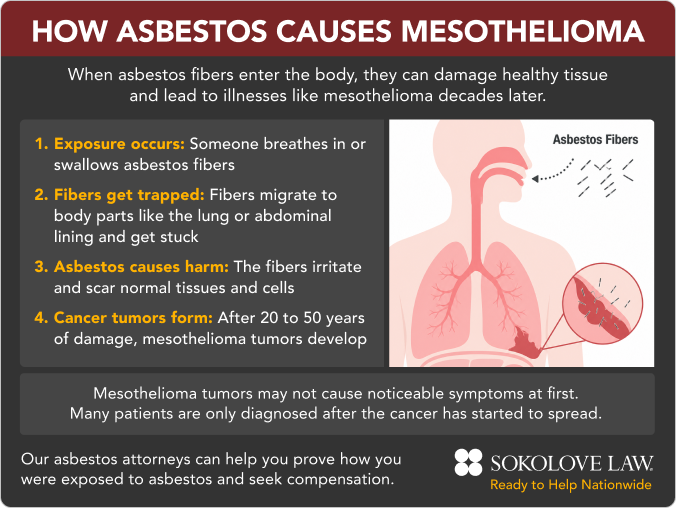
Asbestos causes mesothelioma by damaging the mesothelium, the body’s internal lining. The asbestos fibers get stuck in the body, irritating healthy tissues. This can eventually lead to the development of mesothelioma tumors.
Here’s how asbestos causes mesothelioma, according to Penn Medicine:
- Initial exposure: A person breathes in or swallows asbestos fibers, often at a job site, in older buildings, or from products containing asbestos.
- Fibers become trapped: Asbestos fibers make their way to different parts of the mesothelium, the thin lining around the lungs, abdomen, testicles, or heart, and get stuck there.
- Damage occurs: The fibers cause chronic inflammation and scarring in nearby cells. This leads the DNA of normal cells and tissues to become damaged, which means they could grow uncontrollably and form cancer tumors, per the American Cancer Society (ACS).
- Mesothelioma develops: After a long latency period of typically 20 to 50 years after first exposure, mesothelioma tumors may form out of the scar tissue.
- The cancer gets diagnosed: Symptoms like shortness of breath, chest or abdominal pain, persistent cough, and unexplained weight loss usually don't appear until the disease is advanced, which is part of why mesothelioma is often detected and diagnosed at later stages.
Those who are most likely to develop mesothelioma regularly worked with or around asbestos-containing materials at their jobs.
However, no level of exposure to asbestos is considered safe, according to the Occupational Safety and Health Administration (OSHA). Even just a few days’ worth of asbestos exposure has caused mesothelioma in some cases.
Is Mesothelioma Always Caused by Asbestos?
Mesothelioma is always caused by asbestos. As early as the 1930s, companies had research showing mesothelioma was caused by asbestos. The Sumner Simpson papers show how manufacturers hid the risks to avoid liability for poisoning of American workers, something that still causes confusion today.

"If there's no asbestos, there's no mesothelioma, it's that simple. If you have mesothelioma, and you say, ‘Well, I've never been exposed to asbestos,’ you're exposed to it. You just don't know where, you don't know when.”
– Dr. Raja Flores, Mesothelioma Specialist
At Sokolove Law, we can help prove your asbestos exposure. Our mesothelioma attorneys can research any possible ways you may have been exposed, whether it's through somewhere you or a loved one worked, from the products you used at home, DIY activities like changing brakes or home renovations, or more.
We also have a warehouse worth of evidence about the asbestos industry to pinpoint specific products you may have come into contact with and identify which companies made them.
How Long Does It Take to Develop Mesothelioma?
Because of the long latency period, mesothelioma takes 20 to 50 years to develop after exposure to asbestos. As a result, most mesothelioma patients are diagnosed later in life, typically decades after working with or around asbestos products.
Rates of mesothelioma increase with age before leveling off for those aged 90 or older, according to the National Cancer Institute (NCI) SEER program.
Here are SEER data rates of mesothelioma cases by age:
| Ages | Cases per 100,000 People |
|---|---|
| 49 and under | 0.1–0.2 |
| 50-54 | 0.4 |
| 55-59 | 0.7 |
| 60-64 | 1.0 |
| 65-69 | 1.9 |
| 70-74 | 3.2 |
| 75-79 | 5.6 |
| 80-84 | 7.8 |
| 85-89 | 8.5 |
| 90+ | 5.5 |
These figures show that it’s important for anyone exposed to asbestos to be aware of the risk of developing mesothelioma, especially as time goes on.
Rates of Mesothelioma in Younger Patients
The average age of a mesothelioma patient at the time of diagnosis is 72 years old, per the ACS. However, it's possible for younger adults to get sick with mesothelioma too. In very rare cases, children as young as 3 years old have been diagnosed with mesothelioma.
Occupational exposure rates decreased among younger patients, according to the American Society of Clinical Oncology (ASCO). Only 40% of mesothelioma patients diagnosed under the age of 50 had occupational exposure. This dropped to 16% in those under the age of 35.
In younger patients, it may be harder for them to trace their exposure without help, since many may have been exposed indirectly.
If you aren’t sure how you were exposed to asbestos, we may be able to assist you. Our team will ask you about your work and personal history to determine your exposure.
Using our database of evidence and decades of experience litigating mesothelioma lawsuits, we’re well-prepared to prove how you were exposed and to pursue compensation on your behalf.
Since 1979, Sokolove Law has secured more than $5.6 Billion for thousands of mesothelioma victims and their families.
Get a Free Case ReviewHow Much Asbestos Exposure Causes Mesothelioma?
There is no safe level of asbestos exposure. Even short exposures could lead to mesothelioma later in life, per OSHA. Once you’re exposed to asbestos, there’s no way to lower your risk of getting mesothelioma later in life.
Additionally, the more you’ve been exposed to asbestos, the greater your chances of developing mesothelioma, according to the ACS.
| Asbestos Exposure Duration | Percentage of Mesothelioma Cases |
|---|---|
| 0-0.2 fibers per milliliter of air (f/ml) | 15% |
| 0.2-1.25 (f/ml) | 18% |
| 1.25-2.0 (f/ml) | 32% |
Source: Safety and Health at Work
While just a few days worth of exposure to asbestos fibers can cause you to get sick, the more you’re exposed, the greater the odds. 64% of mesothelioma plaintiffs were directly exposed to asbestos fibers, according to KCIC. Many likely handled asbestos products day in and day out at their jobs.

“We have years of research and file drawers full of evidence that will show us what products contain asbestos.”
– Ricky LeBlanc, Managing Attorney of Sokolove Law
Pleural Mesothelioma Causes
The most common type of this cancer, pleural mesothelioma is caused by breathing in asbestos fibers. The fibers then migrate from the lungs into the pleura or lung lining, leading to long-term irritation and ultimately pleural mesothelioma, according to the ACS.
The greater your exposure, the higher your risk of pleural mesothelioma. An Occupational and Environmental Medicine study noted that the odds ratio of pleural mesothelioma ranged from 4.4 for minimal exposure (less than 1 f/ml per year) to 62.1 for major exposure (greater than 10 f/ml per year).
Studies have shown that those with other asbestos-related diseases are more likely to develop pleural mesothelioma. Patients with asbestos pleural plaques were 7 times more likely to later be diagnosed with mesothelioma, as noted by the Journal of the National Cancer Institute.
Over 80% of all pleural mesothelioma patients are men, according to Lung Cancer International. The fact that men dominated industries that used asbestos, such as construction and shipbuilding, help account for the high rates.
Peritoneal Mesothelioma Causes
Peritoneal mesothelioma is caused by swallowing asbestos fibers. The fibers get trapped in the peritoneum or lining of the abdominal cavity and cause cancer to develop over time, according to the ACS.
Those with an increased risk of peritoneal mesothelioma include:
- Cement workers: Those who handled asbestos cement were more likely to develop peritoneal mesothelioma than pleural mesothelioma, as noted by Cancer Epidemiology.
- Insulation workers: Peritoneal mesothelioma was the most common type reported among insulation workers with mesothelioma, according to the U.S. Environmental Protection Agency (EPA).
- Women: Women are more likely to develop peritoneal mesothelioma than men, per MD Anderson Cancer Center. Exposure to asbestos in talcum powder or through a loved one’s work are common causes.
The odds of developing peritoneal mesothelioma may be linked to longer and more significant asbestos exposure than pleural mesothelioma, according to the American Society of Clinical Oncology.
However, just 33% to 50% of peritoneal mesothelioma patients were able to recall their asbestos exposure history, as per the Annals of Translational Medicine. At Sokolove Law, our mesothelioma attorneys are often able to help prove our clients' asbestos exposure if they aren't sure or don't remember.
Call us at (800) 647-3434 now for help determining what caused your diagnosis, exploring cancer treatments, and pursuing compensation.
Pericardial Mesothelioma Causes
Pericardial mesothelioma is a rare cancer that develops after breathing in asbestos fibers, which travel from the lungs and get stuck in the pericardium or heart lining. Asbestos exposure leads to a 4 times greater risk of pericardial mesothelioma, according to MDPI.
The majority of pericardial mesothelioma cases were attributed to occupational asbestos exposure, as reported by the Scandinavian Journal of Work, Environment and Health:
| Type of Asbestos Exposure | Percentage of Pericardial Mesothelioma Cases |
|---|---|
| Occupational exposure | 55% |
| Non-occupational exposure | 4% |
| Unknown | 40% |
The majority of pericardial mesothelioma patients in the study were men, accounting for about 62% of all diagnoses. Men made up the majority of pericardial mesothelioma cases (84%) stemming from occupational asbestos exposure.
Testicular Mesothelioma Causes
Testicular mesothelioma is caused after asbestos fibers enter the body and migrate to the tunica vaginalis (lining of the testicles). It is the rarest type with just 289 recorded cases according to the journal Environmental Health.
Roughly 66% of testicular mesothelioma cases are believed to be caused by occupational asbestos exposure, according to the Scandinavian Journal of Work, Environment and Health.
Just 3% of testicular mesothelioma cases are linked to non-occupational exposures.
Mesothelioma specialists can use a patient's asbestos exposure history to help distinguish this cancer from other testicular tumors and recommend treatment plans that suit their case.
Causes of Mesothelioma Cell Types
There are three main types of mesothelioma cancer cells that make up tumors. All three types are only caused by exposure to asbestos fibers.
As part of the diagnostic process, medical oncologists review biopsies (small samples of tissue) under a microscope to see if a patient has any type of mesothelioma cells.
The mesothelioma cell types are:
- Epithelioid mesothelioma, the most common type
- Sarcomatoid mesothelioma, the rarest and most aggressive type
- Biphasic mesothelioma, when tumors have both epithelial and sarcomatoid cells
In some cases, oncologists may also see asbestos fibers within the sample, helping them to rule out other possible diagnoses.
If you have mesothelioma, the odds are fairly good it's not your fault. It wasn't from your tobacco smoking habit if you had one, and it wasn't from any other vice you can think of. It was probably because you were a hardworking American that went every day into work, and when you got there, you were exposed to asbestos.”
– Ricky LeBlanc, Managing Attorney of Sokolove Law
Epithelioid Mesothelioma Causes
Epithelioid or epithelial mesothelioma accounts for 70% of diagnoses and forms when healthy epithelial cells are exposed to asbestos, according to UPMC Hillman Cancer Center.
Epithelial cells make up the lining of various body parts. However, long-term damage from asbestos can trigger mutations that cause the cells to collect into tumors.
Causes of Sarcomatoid Mesothelioma
Sarcomatoid mesothelioma may be caused by changes in epithelioid mesothelioma cells following asbestos exposure, according to a report from the journal Molecular Cancer.
Sarcomatoid mesothelioma is the rarest type, accounting for only 10-15% of cases, per the UPMC Hillman Cancer Center.
Biphasic Mesothelioma Causes
Biphasic or mixed mesothelioma typically forms after chronic asbestos exposure, according to Case Reports in Pulmonology. With this type, mesothelioma tumors contain both epithelial and sarcomatoid cells.
The Molecular Cancer report notes that biphasic mesothelioma marks a transitional phase from when epithelial mesothelioma cells are turning into sarcomatoid cells.
Jobs That Can Cause Mesothelioma
On-the-job exposure to asbestos is one of the most common causes of mesothelioma cancer. Over 27 million Americans risked occupational exposure to asbestos between 1940 and 1979, according to the Agency for Toxic Substances and Disease Registry (ATSDR).
Working with or around asbestos at a job meant regular exposure for years or even decades, which has been shown to increase the risk of mesothelioma later in life.
Jobs that could cause mesothelioma through asbestos exposure include:
- Automobile workers
- Boilermakers
- Construction workers
- Demolition workers
- Drywall removers
- Electricians
- Factory workers
- Firefighters
- Industrial workers
- Insulation installers
- Mechanics
- Miners and millers
- Plumbers
- Railroad workers
- Shipyard workers
- Teachers
- Textile workers
- U.S. military service
In these roles, workers often handled asbestos-containing materials directly. Many workers didn't even know they were being exposed to asbestos. Those who were aware didn't understand the risks.

“I never thought I would be affected by something like mesothelioma. It never occurred to me that I even was exposed, until I was diagnosed.”
– Alan Bonnin, Asbestos Exposure Victim
Asbestos-related companies concealed the truth for decades to make significant profits while poisoning the workforce. Corporate leaders hid evidence and engaged in a corporate cover-up — and even today, families are paying the price.
Find Out How You Were Exposed
At Sokolove Law, we've helped thousands of patients determine how they were exposed to asbestos. Let us figure out what happened and work to get you answers.
Risks of Mesothelioma by Job Type
Each specific job came with a different level of asbestos exposure. Workers who breathed in higher concentrations of air contaminated with asbestos fibers for longer periods of time run a higher risk of mesothelioma today.
| Occupation | Average Exposure | Mesothelioma Cases |
|---|---|---|
| Asbestos cement workers in Louisiana | 5.64 fibers per cubic centimeter (f/cc) | 0 |
| Asbestos friction products workers in Connecticut | 5.72 f/cc | 2 |
| Insulation workers across the United States | N/A | 356 |
| Steel workers across the United States | 1.09 f/cc | 33 |
| U.S. Navy Veterans | 51 f/cc | 1445 |
A number of other occupations, including insulation work, pipefitting, boilermaking, carpentry, maintenance work, electrical work, all had exposures ranging from 2 to 10 f/cc, according to the Journal of Toxicology and Environmental Health.
With that said, every mesothelioma diagnosis is unique. Even those who never were exposed to asbestos on the job have gone on to develop mesothelioma decades after the fact.
If you have a history of occupational asbestos exposure, it’s important to share that information with your health care team. It may help guide screening, such as chest X-rays or CT scans, especially when early possible symptoms are not yet clear.
How Secondary Asbestos Exposure Causes Mesothelioma
It wasn’t just those who worked with asbestos-containing materials who were in danger of mesothelioma. Secondhand or secondary asbestos exposure has caused many cases of this cancer too.
Those with domestic or household exposure to asbestos, which often occurred secondhand, had double the risk of pleural mesothelioma, according to Occupational and Environmental Medicine.
Here’s how secondhand exposure causes mesothelioma:
- Dust is brought home on clothing and tools
- Work gear is handled or washed at home
- Fibers spread through shared living spaces
- Loved ones breathe in or swallow the fibers
Additionally, a recent study of 1,780 women married to asbestos cement plant workers found that this group had roughly a 25-fold elevated risk of mesothelioma due to secondary exposure, as reported by the Annals of Translational Medicine.
The CDC also noted that homemaking accounted for 22% of all mesothelioma deaths among women in a recent report — more than other female-dominated occupations like teaching and health care work, where they were directly exposed.
What Causes Mesothelioma Other Than Asbestos?
If you've been diagnosed with mesothelioma, you may have come across information about other potential causes. However, many have been disproven or only have limited evidence to support them.
Right now, asbestos is the most significant cause of mesothelioma. If you or someone you love has been diagnosed, it’s likely due to a history of asbestos exposure — even if you can't remember exactly when, where, or how.
Disproven causes of mesothelioma include:
- Cigarette smoke: This causes lung cancer but not mesothelioma, per the NCI.
- Erionite exposure: This mineral was not mined and used commercially to the same extent asbestos was, according to the Annals of Work Exposures and Health. As a result, it’s not considered a significant risk factor for mesothelioma.
- Fiberglass is not considered a carcinogen per the International Agency for Research on Cancer. However, asbestos companies like Owens Corning sold fiberglass and asbestos insulation at the same time, leading to confusion.
- Genetic changes: BAP1 gene mutations alone don’t cause mesothelioma, according to Fox Chase Cancer Center. They can increase your risk of mesothelioma, but only if you’ve already been exposed to asbestos.
- Radiation: Long-term research into mesothelioma and radiation therapy has not shown a definitive link. As recently as 2022, the Icahn School of Medicine at Mount Sinai noted that the link between radiation and mesothelioma was still controversial.
- Silica: Silica dust can cause lung cancer, but it doesn’t contain asbestos and can’t cause mesothelioma. However, silica could worsen the harm that asbestos does to mesothelial cells, according to the medical journal Thorax.
- Simian virus 40 (SV40): Research effectively proved that SV40 didn’t cause mesothelioma, per the National Organization for Rare Disorders.
- Talc: Many talcum powder products were contaminated with asbestos, causing mesothelioma as a result of that. Major corporations like Johnson & Johnson (J&J) sold talcum powder for decades despite repeatedly finding asbestos samples during company testing, according to Reuters.
“There is a lack of studies on the dose–response relationship between agents other than asbestos and mesothelioma, and the studies that do exist reported conflicting results.”
– Safety and Health at Work Report
Today, asbestos remains the most definitively proven cause of mesothelioma. As mesothelioma specialist Dr. Raja Flores says: “If there’s no asbestos, there’s no mesothelioma. It’s that simple.”
Is Mesothelioma Caused by Smoking?
Mesothelioma is not believed to be caused by tobacco smoke, according to agencies like the International Journal of Environmental Research and Public Health and the NCI.
Right now, more information is needed to know for sure whether smoking increases the risk of mesothelioma. However, you may be at a higher risk of lung cancer if you smoked and were exposed to asbestos.
“The two agents, tobacco smoke and asbestos, actually operate with a synergistic effect, meaning that your likelihood of developing lung cancer from just being a smoker or because you're exposed to asbestos is actually multiplied by one another.
– Ricky LeBlanc, Managing Attorney of Sokolove Law
Can Talcum Powder Cause Mesothelioma?
Asbestos-contaminated talcum powder can cause mesothelioma and other asbestos-related cancers like ovarian cancer. Talc and asbestos often form close to one another in rock deposits, and mining can lead to cross-contamination.
Major manufacturers of talcum powder, like Johnson & Johnson, repeatedly found asbestos fibers in samples of their talc products dating as far back as the 1950s. However, J&J allegedly worked to downplay and hide their findings for fear that it would impact profits, according to Reuters.
In over 73% of women diagnosed with peritoneal mesothelioma, their only known exposure to asbestos was from talcum powder products, as per the Journal of Occupational Medicine and Toxicology.
As of May 2026, more than 90,000 lawsuits have been filed by families who claim talcum powder caused mesothelioma and other cancers. J&J had to pay over $2.5 Billion in 2025 alone to resolve various talcum powder cancer claims.
Can BAP1 Cause Mesothelioma?
BAP1 is a gene that protects you from developing cancer. If mutated, the BAP1 gene can increase the risk of mesothelioma, but only following asbestos exposure. A BAP1 mutation alone will not cause mesothelioma. There always needs to be some sort of exposure to asbestos.
Flawed and contradictory research by Dr. Michele Carbone, a doctor who has received millions of dollars in funding from defending asbestos-related companies, has led some to believe that BAP1 causes mesothelioma.
Don’t be fooled: Asbestos remains the only proven cause of mesothelioma, as noted by leading mesothelioma oncologists and researchers, including Dr. Raja Flores and Dr. Hedy Lee Kindler.

“These genes, particularly BAP1, will make patients more sensitive to the carcinogenic effects of asbestos … rather than serving as a direct cause of mesothelioma.”
– Dr. Hedy Kindler, Mesothelioma Specialist
How to Prevent Mesothelioma
The best way to prevent mesothelioma is to reduce or avoid asbestos exposure. There’s no way to lower the risk of mesothelioma if you’ve already been exposed, even if you avoid further exposure, according to the ACS.
Mesothelioma prevention efforts include:
- Avoiding disturbance of asbestos-containing materials
- Following safety rules at work
- Using protective equipment when needed
- Having older buildings inspected before renovation
- Fighting for a total U.S. asbestos ban that addresses legacy asbestos (products left in place in older buildings)
If you came into contact with asbestos and are worried about developing mesothelioma, discuss your exposure history with your doctor. They may be able to recommend steps to potentially diagnose you in the early stages, when more mesothelioma treatment options might be available.
“Currently, early detection remains challenging due to the disease’s long latency period. However, there are protocols in place for high-risk individuals.”
– Dr. Antonio Giordano, Mesothelioma Specialist
Proving What Caused Mesothelioma for Compensation
There's no other cause of mesothelioma besides exposure to asbestos. Showing how asbestos caused mesothelioma is crucial to pursuing compensation that can help your family afford medical expenses and other costs.
At Sokolove Law, our team of mesothelioma lawyers and investigators can use warehouses worth of evidence related to the asbestos industry, as well as our asbestos job site database, to build a legal claim showing how asbestos caused your cancer.
Founded in 1979, no other law firm has handled as many asbestos cases as ours. Our asbestos attorneys have recovered over $5.6 Billion to date for families through mesothelioma lawsuits.
If you or somebody you love was recently diagnosed, don't wait to explore your legal options. Time is limited to file mesothelioma lawsuits, so you can miss out if you delay — even if you would otherwise qualify.
Call (800) 647-3434 now or fill out our contact form to see how we may be able to help prove the cause of mesothelioma in your case, and seek compensation for your family.
Causes of Mesothelioma FAQs
Is mesothelioma caused by asbestos?
Yes, mesothelioma is caused by breathing in or swallowing asbestos fibers, which cause long-term harm to the body and eventually trigger tumors to form. Exposure often occurred on job sites. In fact, over 27 million people were exposed to asbestos at their jobs between 1940 and 1979 alone, according to the ATSDR.
There are no other proven causes of mesothelioma besides asbestos. If you've been diagnosed, you were exposed at some point earlier in your life — even if you don't necessarily remember when or how.
We can help prove how asbestos caused mesothelioma and pursue financial compensation for your family. Contact Sokolove Law now to get started.
What is mesothelioma caused by?
Mesothelioma is caused by exposure to materials that contain asbestos. Working with or around products that contain asbestos, such as insulation, paint, or gaskets, among many more, could release fibers into the air.
64% of mesothelioma patients who filed lawsuits suffered primary exposure to asbestos at their jobs, per KCIC. 34% of plaintiffs reported both primary as well as secondary exposure, which occurs when living with loved ones who worked around asbestos fibers.
You can inhale or swallow the fibers without noticing, trapping them in your body. The fibers are so durable that they cannot be broken down, causing long-term irritation that eventually leads to the formation of mesothelioma tumors.
How much exposure to asbestos causes mesothelioma?
There is no safe level of exposure to any type of asbestos, according to organizations like OSHA. Even just a few days of asbestos exposure can lead to mesothelioma.
However, those who were exposed to asbestos for longer periods or who suffered higher concentrations of exposure could be more likely to develop mesothelioma later in life.
Is asbestos the only cause of mesothelioma?
Yes, asbestos is the only significant cause of mesothelioma. Many other potential causes have been disproven through ongoing research efforts.
For instance, BAP1 gene mutations in and of themselves will not cause mesothelioma — they merely increase the risk of the cancer among those exposed to asbestos.
Talcum powder can also contribute to mesothelioma, but this is because talc products were contaminated with asbestos for decades.
What causes pleural mesothelioma?
Malignant pleural mesothelioma is caused by breathing in asbestos fibers. The fibers migrate from the lungs to the pleura (lining of the lungs), where they cause chronic irritation to the tissues there. Pleural mesothelioma is the most common type of mesothelioma caused by asbestos exposure.
If you’ve been recently diagnosed, we may be able to help prove how you were exposed and pursue compensation from the manufacturers responsible. Call (800) 647-3434 to learn about your legal options.
What causes peritoneal mesothelioma?
Peritoneal mesothelioma develops after asbestos fibers get trapped in the lining of the peritoneum or abdominal lining, usually from being swallowed.
The immune system can’t break down these fibers, and over time they trigger damage to healthy cells, mutating them into malignant ones that collect into cancer tumors.
Is mesothelioma contagious?
No, mesothelioma is not contagious. You cannot “catch” it like you would the flu. However, you may be at a higher risk of mesothelioma if a loved one has been diagnosed or if there's a known history of asbestos exposure in your family.
In many past cases we've handled, family members worked in similar jobs that relied on asbestos. For example, sons may have followed fathers into automotive or construction work, industries that both heavily used asbestos.
Other times, those who worked with asbestos could expose loved ones secondhand by bringing stray fibers home on clothing or skin.
Can smoking cause mesothelioma?
Smoking has not been shown to cause mesothelioma, according to leading organizations like the National Cancer Institute (NCI).
Cigarette smoke can contribute to other cancers, notably lung cancer, among those exposed to asbestos. More evidence is needed to definitively prove if smoking contributes to mesothelioma cases specifically.
Who is at high risk for mesothelioma?
While anyone who came in contact with asbestos could later develop mesothelioma, those with higher, long-term exposures run the highest risk of mesothelioma.
Some of those at the highest risk for mesothelioma include:
- Those who worked with or around asbestos at jobs like shipbuilding
- Family members of asbestos workers
- U.S. military veterans exposed to asbestos products while serving
In fact, over 33% of new mesothelioma diagnoses involve veterans who were exposed during service or in a civilian job afterward.
Get a free case review now for help determining how your exposure history led to a mesothelioma diagnosis and if you’re eligible for compensation for expenses.
Can mesothelioma cause prostate cancer?
No, mesothelioma cannot cause prostate cancer in and of itself. However, exposure to asbestos is also associated with a higher risk of prostate cancer, according to the Permanente Journal.
Some mesothelioma patients have also been diagnosed with prostate cancer at the same time. This is known as a double malignancy, but it isn’t the same as mesothelioma “causing” a secondary cancer.
Does mesothelioma cause pleural effusion?
Yes, mesothelioma causes pleural effusion, a fluid buildup in the lung lining. Having cancer within the pleura causes fluid to accumulate, leading to symptoms like chest pain, shortness of breath, and sometimes the collapse of a lung.
Pleural effusions are often one of the earliest symptoms of mesothelioma. Over 80% of cases start with effusions according to Pathology International. If you’re dealing with pleural effusions, it’s important to find out whether or not mesothelioma is causing them.
“They found out that there was over 2 liters of fluid on his left lung,” said Dee, wife of a mesothelioma survivor who initially suffered from pleural effusions. “They were amazed that he was even able to breathe, period.”
What are childhood mesothelioma causes?
Mesothelioma in childhood is incredibly rare, with fewer than 300 recorded cases according to the National Cancer Institute (NCI). It's believed that secondary exposure to asbestos from parents or other relatives is a major cause.
For example, a 16-year-old girl was diagnosed with mesothelioma, with her and her mother now working to raise awareness about the dangers of renovating old homes with the substance still present. Another girl was diagnosed at the age of just 3, courageously battling the cancer for nearly a decade until her death.
Does pleural plaque cause mesothelioma?
Pleural plaque is an asbestos-related disease in which a protein known as collagen collects in your lung lining. It doesn't cause mesothelioma, but having it could mean you're at a higher risk due to your asbestos exposure history.
Pleural plaques were strongly correlated with a higher incidence of mesothelioma in a recent report from the American Journal of Industrial Medicine.
At Sokolove Law, we have medical experts who can review tests like X-rays to look for pleural plaques and evidence of fibers, both of which help prove that asbestos caused your diagnosis.
What causes mesothelioma and lung cancer?
Mesothelioma and lung cancer can both be caused by asbestos exposure. Mesothelioma develops after asbestos fibers get trapped in the linings of various organs, while lung cancer can form if the fibers stay in the lungs themselves.
At Sokolove Law, we may be able to help determine if asbestos contributed to your cancer diagnosis and pursue compensation on your behalf. Call (800) 647-3434 now.
