
What Is the Latency Period for Mesothelioma?
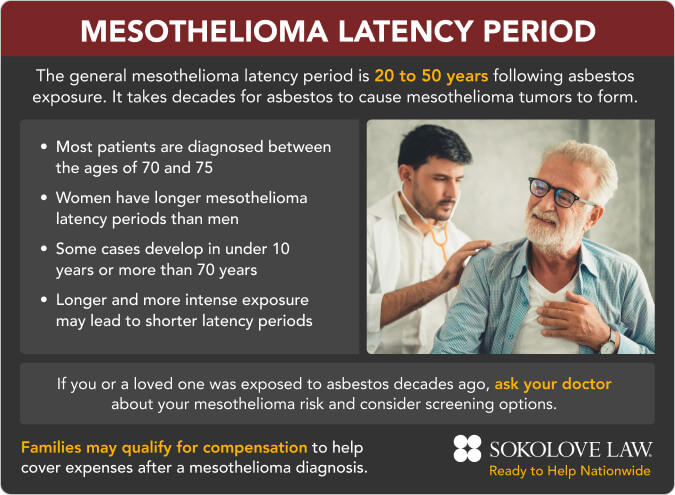
Mesothelioma latency period refers to how long it takes for this cancer to form after exposure to asbestos fibers. The typical latency period for mesothelioma ranges from 20 to 50 years, according to Penn Medicine.
Asbestos fibers cause slow but worsening irritation to normal cells and tissues in the body. As a result, it often takes decades for mesothelioma to develop.
Learn more about the asbestos latency period and mesothelioma:
- Most mesothelioma patients are diagnosed between ages 70 and 75, which reflects the cancer’s long latency period, according to the American Cancer Society (ACS).
- The median latency period for mesothelioma is 22.8 years, per the medical journal Epidemiology.
- In some cases, the mesothelioma latency period can be as short as 10 years or as long as 70 years.
- Patients with pleural mesothelioma (which develops in the lung lining) are typically diagnosed around 70, as noted by the ACS.
- Peritoneal mesothelioma (which affects the abdominal lining) has a shorter average latency period. Most patients are diagnosed in their 50s, per the ACS.
Regardless of how old someone is when they develop mesothelioma, Sokolove Law can help patients and their families understand their legal options after a mesothelioma diagnosis.
As a national asbestos law firm, we’ve helped more than 9,600 mesothelioma patients since 1979. We can prove how you were exposed to asbestos and pursue compensation on your behalf.
Since 1979, Sokolove Law has secured over $5.6 Billion for thousands of mesothelioma victims and their families.
Get a Free Case Review
Why Is the Asbestos Latency Period So Long?
Mesothelioma doesn’t develop immediately after asbestos exposure. It takes chronic irritation from asbestos to cause mesothelioma to form.
As a result, the mesothelioma latency period after asbestos exposure is usually several decades long.
Here’s why it takes so long for asbestos to cause mesothelioma:
- Those exposed to asbestos breathe in or swallow microscopic fibers.
- The fibers get trapped in the mesothelium (the body’s internal lining), and the immune system can’t break them down.
- Asbestos causes long-term irritation, scarring, and DNA damage, leading to the death of healthy cells.
- After 20 to 50 years, this can cause carcinogenesis, or the development of mesothelioma cancer.
Since it takes so long for mesothelioma to develop, adults may not necessarily remember when, where, or how they were exposed.

“It was kind of shocking because my first thought after my diagnosis was, 'Where have I ever been around asbestos?' I had no idea.”
– Dennis, Mesothelioma Patient & Firm Client
At Sokolove Law, we can help prove your asbestos exposure using a warehouse’s worth of evidence on asbestos products. To get started, we’ll ask about your work history since many risked long-term asbestos exposure at job sites.
Factors Affecting Mesothelioma Latency Periods
Mesothelioma latency is such a broad range because many elements play a role in when and why someone could develop this cancer. Each patient’s background and exposure history are unique to their situation.
These factors impact latency periods for mesothelioma and asbestos:
- Age: An older age at the time of exposure is associated with a shorter latency period
- Asbestos exposure history: More exposure is correlated with shorter latency periods
- Cancer type: Some mesothelioma types develop in less time
- Gender: Women have longer asbestos latency periods than men
Learn more about the specific factors that influence mesothelioma latency and patient outcomes below.
Asbestos Latency Period by Age
Broadly speaking, the risk of mesothelioma grows with age, according to the Canadian Cancer Society. Incidence rates of mesothelioma gradually increase before sharply rising among those 75 and older, per Cureus.
The Cureus study authors noted that the cancer’s latency period, as well as the long-term effects of asbestos exposure, are to blame.
| Age | Percentage of Mesothelioma Diagnoses |
|---|---|
| 15 to 24 | 0.19% |
| 25 to 34 | 0.68% |
| 35 to 44 | 1.86% |
| 45 to 54 | 5.43% |
| 55 to 64 | 14.85% |
| 65 to 74 | 29.28% |
| 75 and up | 47.72% |
Around 77% of those newly diagnosed with mesothelioma are aged 65 or older, reflecting the asbestos latency period and accounting for chronic exposure at job sites, according to Cureus.
The British Journal of Cancer noted that just 3.9% of patients had a latency period of less than 10 years. The younger someone was at first exposure, the shorter the latency period.
Asbestos Latency Periods and Childhood Mesothelioma Cases
Between 2% and 5% of mesothelioma cases develop in those aged 20 or younger, according to the National Cancer Institute (NCI).
Since the vast majority of mesothelioma cases develop decades after exposure, it’s not fully clear why the latency period is so short among children and young adults.
These factors may impact childhood mesothelioma latency periods:
- Gene mutations: Issues with the ALK gene have been found in several cases of childhood mesothelioma.
- House or school renovations: Remodeling homes and schools built with asbestos could potentially release fibers into the air, exposing children.
- Secondary exposure to asbestos: Those who worked with or around asbestos could bring fibers back home unknowingly on their clothing or skin, putting kids and spouses at risk. Long-term exposure could have contributed to a childhood mesothelioma diagnosis.
- Talcum powder: Children may have been put at risk of asbestos exposure through contaminated talcum powder products that mothers trusted like baby powder.
The rate of mesothelioma among those exposed before age 15 was roughly 40% compared to those initially exposed in adulthood, per the Annals of Occupational and Environmental Medicine.
“Considering its long latency period, mesothelioma in the young is less likely to be due to occupational exposure to asbestos. Patients may have a genetic predisposition or may have exposures to carcinogenic fibers from an early age.”
– OncoTarget
Asbestos Latency Periods and Exposure History
There’s no safe level of asbestos exposure, so anyone exposed could get mesothelioma. However, factors like when, where, and for how long someone was exposed to asbestos could significantly affect the odds of developing mesothelioma and the latency period of when it develops.
More intense or long-term exposure, typically through a job, may lead to shorter latency periods, according to Thoracic Cancer. Those with indirect or at-home exposures have longer latencies of more than 50 years in some cases.
Studying asbestos latency, the British Journal of Cancer reported that:
- Latency periods were longer for those who had 10 to 19 years of occupational exposure compared to those exposed for less than 10 years
- Latency periods were shorter depending on the year of first exposure on the job
- A higher age at first exposure was linked to a shorter mesothelioma latency period
Workers exposed to asbestos between the ages of 20 and 29 had a 6% shorter latency compared to those who were first exposed before the age of 20.
Mesothelioma latency appears to be influenced by both the intensity and timing of asbestos exposure. Research suggests latency periods may be shorter among workers with heavier occupational exposures and those first exposed at older ages, though the relationship is complex and varies between individuals.
Mesothelioma Latency Period by Cancer Type
Mesothelioma is classified into different types depending on where the cancer forms in the body. Some types of mesothelioma have shorter latency periods than others.
Here are mesothelioma latency periods for specific types:
- Pleural mesothelioma: Pleural mesothelioma incidence (or number of cases) peaks around 45 years after asbestos exposure, according to Oncotarget. The average age of diagnosis for pleural mesothelioma is 70 years old, as noted by the ACS.
- Peritoneal mesothelioma: Most patients are diagnosed around age 50, per the ACS. However, peritoneal mesothelioma incidence rates climb over time without a peak, as noted by Oncotarget.
- Testicular mesothelioma: The testicular mesothelioma latency period was 47.5 years, with patients having been exposed to asbestos for an average of 10.5 years, according to Environmental Health.
- Pericardial mesothelioma: This type of mesothelioma develops in the lining of the heart 30 to 40 years after asbestos exposure, per Thoracic Medicine.
An estimated 63.6% of patients diagnosed before the age of 40 had peritoneal mesothelioma, according to the Journal of Pediatric Surgery. However, it’s not fully understood why the latency period is shorter for certain mesothelioma types.
At Sokolove Law, our registered nurses can help you understand your medical options for any type of mesothelioma. Call (800) 647-3434 now to learn more.
Asbestos Latency Period by Gender
Mesothelioma and asbestos latency periods tend to be shorter for men than for women. The latency period for women with pleural mesothelioma was just over 50 years compared to 48 years in men, according to BMJ Open Access.
The mesothelioma latency period is 29% longer for women with mesothelioma than for men, as noted by Epidemiology.
It's still not fully clear why women have longer latency periods. However, women were less likely to suffer intense on-the-job asbestos exposure, which might help explain the difference, per the British Journal of Cancer.
Does Smoking Impact Mesothelioma Latency Period?
At this time, there isn't sufficient evidence showing that smoking affects mesothelioma latency periods, according to the British Journal of Cancer.
Right now, smoking is not believed to cause or contribute to mesothelioma, as noted by the U.S. National Library of Medicine, ACS, and other leading medical organizations. Asbestos is the only known cause of mesothelioma.

"If there's no asbestos, there's no mesothelioma, it's that simple. If you have mesothelioma, and you say, ‘Well, I've never been exposed to asbestos,’ you're exposed to it. You just don't know where, you don't know when.”
– Dr. Raja Flores, Mesothelioma Specialist
Smoking does increase the risk of lung cancer in those exposed to asbestos, per the ACS. Smoking was also associated with a shorter lung cancer latency period, per the International Journal of Environmental Research and Public Health.
However, study authors noted that patient smoking histories didn’t directly affect lung cancer latency periods.
Does Everyone Exposed to Asbestos Get Mesothelioma?
No, not everyone who is exposed to asbestos will develop mesothelioma, per the Mayo Clinic. Mesothelioma is fairly rare, with only around 3,000 new cases per year.
It’s possible to develop other asbestos-related diseases or cancers, many of which have similar latency periods to mesothelioma. Others may never get sick from asbestos exposure, according to the NCI.
Here are other asbestos-related disease latency periods:
- Asbestosis is a noncancerous lung illness with a latency period of 20 to 40 years per the Agency for Toxic Substances and Disease Registry (ATSDR).
- Asbestos lung cancer has a latency period of 40.1 years per the International Journal of Environmental Research and Public Health. It accounts for most asbestos-related deaths.
- Ovarian cancer may impact women who were exposed to asbestos in talcum powder. The typical latency period is 30 to 40 years, per the Annals of Epidemiology.

“We don’t always know why mesothelioma develops in some people and not in others. But we do know that asbestos exposure is the main risk factor.”
– Dr. Joseph Friedberg, Mesothelioma Specialist
At Sokolove Law, we may be able to help those with mesothelioma or other asbestos diseases determine their exposure and pursue compensation. Call (800) 647-3434 now to learn more.
How Latency Period for Mesothelioma Affects Diagnosis and Prognosis
Mesothelioma latency periods can potentially prevent patients from getting diagnosed early on, when the cancer may be easier to treat.
Patients may not remember how they were exposed to asbestos so long ago. It’s easy to mistake early mesothelioma symptoms like a cough or shortness of breath for more common illnesses like the flu.
Moffitt Cancer Center recommends that anyone exposed to asbestos decades ago get mesothelioma screening tests even if they aren’t feeling sick yet. This gives patients a better chance of an early diagnosis and a better health outlook.
Steps to potentially diagnose mesothelioma early include:
- Sharing any asbestos exposure history with your doctor
- Getting diagnostic tests like CT scans and X-rays
- Requesting additional screenings like lung function and blood tests
Patients who develop mesothelioma after a shorter latency period and are diagnosed at a younger age could potentially have a better prognosis (health outlook).
An early diagnosis could potentially help catch mesothelioma when it has just started to form following the latency period, when it hasn't spread and is easier to treat.
Taking Legal Action 20-50 Years After Asbestos Exposure
Because a diagnosis often comes decades after initial exposure due to the latency period, families sometimes may be hesitant to pursue legal compensation for mesothelioma.
At Sokolove Law, we help families impacted by asbestos-related diseases review their legal rights and pursue payouts for health care costs and more — even if they can’t remember when, where, or how they were exposed.
Our experienced mesothelioma lawyers can:
- Handle the legal process on your behalf, making it easier for your family
- Prove your asbestos exposure using our warehouse’s worth of evidence
- Go over your statute of limitations or legal deadlines based on the diagnosis
- Use our 45+ years of experience to build a strong asbestos lawsuit
To date, we’ve recovered more than $5.6 Billion for families harmed by asbestos exposure through mesothelioma lawsuits.
If you or your loved ones are now facing mesothelioma, speaking with our asbestos law firm can help you understand your legal options.

“Hiring Sokolove Law was the smartest thing we ever did. Filing the lawsuit was easy because the firm made it easy. We didn’t have to do anything.”
– John, Mesothelioma Survivor & Firm Client
Get Help Understanding Mesothelioma Latency Periods
If you or your loved ones are facing mesothelioma after asbestos exposure that happened long ago, you don’t have to sort through this alone. At Sokolove Law, we have decades of experience helping families with this cancer.
Our mesothelioma lawyers and on-staff registered nurses can assess your diagnosis and asbestos exposure history to recommend medical and legal options specific to your case.
We’ve supported more than 9,600 for families impacted by asbestos and mesothelioma, with many clients starting to receive compensation in as few as 90 days.
Call (800) 647-3434 now or fill out our contact form to find out how we may be able to assist you or a family member after a mesothelioma diagnosis.
Mesothelioma Latency Period FAQs
What is the latency period for asbestos?
The latency period for asbestos to cause mesothelioma is 20 to 50 years, according to Penn Medicine. After someone breathes in or swallows asbestos fibers, their body may not be able to remove them. Normal tissues and organs suffer long-term irritation from the fibers, eventually triggering cancer.
At Sokolove Law, we may be able to help prove how you were exposed to asbestos decades ago and pursue compensation for mesothelioma. Get a free case review now to learn more.
Why is the asbestos exposure latency for mesothelioma decades long?
Mesothelioma doesn't develop immediately following asbestos exposure. The latency period for mesothelioma is typically decades because it results from long-term, chronic damage to normal tissues. When asbestos fibers enter the body, they get lodged in the linings of different organs like the lungs or abdomen.
From there, gradual irritation that leads to scarring, cell DNA damage, and mutations occur that trigger mesothelioma.
What is the latency period from first exposure to asbestos?
Following first exposure to asbestos, the mesothelioma latency period is typically 20 to 50 years. Those who have higher or longer-term asbestos exposure histories could have shorter latency periods, per Thoracic Cancer.
Broadly speaking, the latency period for mesothelioma varies. In some cases, latency periods of 10 years or less have been reported. Other times, mesothelioma doesn’t develop until 70 years or more after exposure.
In one case, a U.S. veteran developed mesothelioma roughly 70 years after his first exposure, which occurred during World War II.
Will 30 minutes of asbestos exposure hurt you?
Yes, even 30 minutes of asbestos exposure could possibly cause mesothelioma 20 to 50 years later. No level of asbestos exposure is considered safe, per the Occupational Safety and Health Administration (OSHA).
Our asbestos law firm can help determine your exposure and find out your eligibility for compensation.
How long after asbestos exposure do symptoms appear?
Mesothelioma develops slowly over time. Symptoms may not appear until after mesothelioma has spread to stage 3 or stage 4, which are more advanced and harder to treat.
As a result, patients often have a poor life expectancy, which is in part blamed on the latency period, as noted by the Annals of Translational Medicine.
How long does mesothelioma take to develop?
On average, the latency period for mesothelioma after asbestos exposure is decades long. Most patients are not diagnosed until 20 to 50 years after they were first exposed to asbestos-containing materials.
Because of this, malignant mesothelioma patients may not necessarily remember when, where, or how their exposures occurred.
Does everyone who is exposed to asbestos get mesothelioma?
No, only some people who are exposed to asbestos go on to develop mesothelioma later in life, according to the Mayo Clinic.
Others could develop different asbestos-related diseases like lung cancer, ovarian cancer, or asbestosis. These illnesses have similar latency periods to mesothelioma, often forming 20 years or more following exposure.
Get a free case review now to find out how we work to prove asbestos exposure and pursue compensation for asbestos-related diseases.
Can you get mesothelioma from smoking?
No, smoking is not believed to directly cause mesothelioma, according to the ACS. Asbestos is the main cause of mesothelioma. Smoking can contribute to asbestos-related lung cancer, though.
Smoking history doesn’t seem to significantly impact mesothelioma or lung cancer latency periods, as noted by the International Journal of Environmental Research and Public Health.