
Is Mesothelioma a Death Sentence?
Mesothelioma isn’t always 100% fatal. There are documented cases of patients going on to become long-term survivors, living for years or even decades past their initial prognosis.
Sissy Hoffman and Paul Kraus, for example, survived for nearly 29 and 27 years after their diagnoses before passing away from unrelated causes.
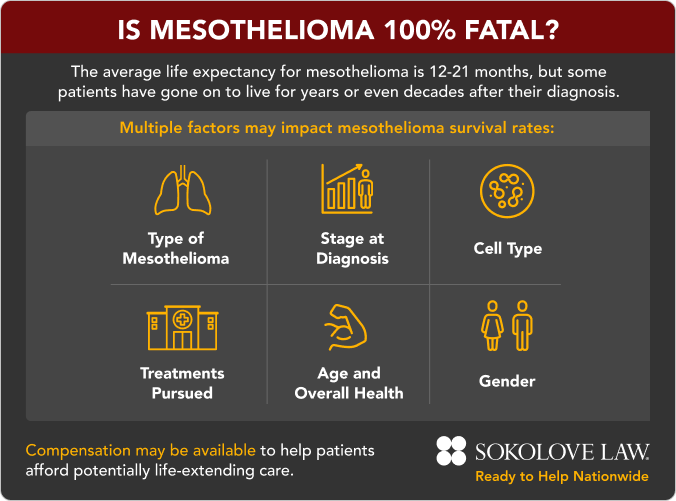
A mesothelioma patient's outlook may depend on:
- The type and stage of mesothelioma at the time of diagnosis
- Their age and overall health
- Which treatment options are pursued
- Whether they get care from a mesothelioma specialist

"So many people go on Dr. Google, and there's a lot of misinformation and information that doesn't apply to that particular individual. They tend to look at the worst — but I tell them this is not a guaranteed death sentence.”
– Dr. Raja Flores, Mesothelioma Specialist
While it can be overwhelming to find out you or someone you love has mesothelioma, staying hopeful and exploring every available treatment option can make a significant difference.
At Sokolove Law, we've helped thousands of mesothelioma patients pursue the compensation they need to access care. Let us help you do the same.
Get Help Paying for Treatment
We’ve secured over $5.5 Billion for thousands of mesothelioma patients and their families nationwide. Let us get you the results you deserve.
How Deadly Is Mesothelioma?
Mesothelioma is considered an aggressive and deadly cancer, with a median life expectancy of 12-21 months, according to data from the National Mesothelioma Virtual Bank.
However, survival rates vary significantly depending on the type of mesothelioma, the stage at diagnosis, and the treatments a patient receives.
Find out about mesothelioma survival rates by type:
- Pleural mesothelioma, the most common type, has an average 5-year survival rate of around 12%, according to Moffitt Cancer Center.
- Peritoneal mesothelioma patients have an average 5-year survival rate of approximately 65%.
- Pericardial mesothelioma has an overall 5-year survival rate of 9%.
- Testicular mesothelioma has an overall 5-year survival rate of 49%.
Epithelioid mesothelioma cells respond better to treatment than sarcomatoid or biphasic types, so patients with this cell type may also potentially have longer survival times.
While mesothelioma remains a serious and often fatal diagnosis, advances in research and clinical trials have given patients more treatment options and better outcomes than ever before.
“The mesothelioma survival rate is rising as researchers learn more about the condition. At present, more mesothelioma patients live for at least one year after diagnosis than ever before. Some have even achieved five-year and ten-year survival, an impressive feat for a cancer that was once thought to be all but untreatable.”
– Moffitt Cancer Center
How Many People Die from Mesothelioma Each Year?
In the United States, approximately 2,200 Americans lose their lives to mesothelioma each year, according to the Centers for Disease Control and Prevention (CDC).
Globally, an estimated 38,400 people die from mesothelioma each year, the World Health Organization (WHO) reports.
Despite these figures, mesothelioma deaths have been gradually declining. Between 2013 and 2023, annual mesothelioma deaths in the U.S. decreased by 28.6%, according to the CDC.
How Many People Have Died from Mesothelioma?
In the United States alone, more than 54,900 people died from mesothelioma between 1999 and 2020, according to JTO Clinical and Research Reports.
Worldwide, an estimated 174,300 people died from mesothelioma across 56 countries between 1994 and 2008, according to the WHO.
As of 2021, the global age-standardized mortality rate for mesothelioma is approximately 0.36 deaths per 100,000 people, according to the Institute for Health Metrics and Evaluation. Mortality rates among men were found to be 3 times higher than in women.
Despite growing awareness about the dangers of asbestos, bans on the use of this mineral, and a decrease in workplace exposure, people are still being diagnosed and dying from mesothelioma today.
Why Is Mesothelioma So Deadly?
In addition to being an aggressive cancer, mesothelioma is so deadly because it's rarely caught early. Symptoms can take 20-50 years to appear, and by the time many patients receive a diagnosis, the disease has reached an advanced stage.
When mesothelioma becomes widespread, treatment options become limited, and controlling the disease becomes even more challenging.
Several factors contribute to why the cancer is so deadly, including:
- A long latency period, which often leads to a delayed diagnosis
- Its aggressive nature, which allows it to spread quickly throughout the body
- Fewer effective treatment options compared to other cancers
- Its location in or near vital organs like the lungs, heart, and abdomen
Together, these issues make mesothelioma one of the most difficult cancers to diagnose and treat. Find out more about why mesothelioma is so deadly.
Long Latency Period & Late Diagnosis
Mesothelioma can take anywhere from 20 to 50 years to develop after exposure to asbestos. By the time symptoms appear, the cancer is often already at an advanced stage. Around 30% of pleural mesothelioma patients are diagnosed at stage 4, according to Clinical Epidemiology.
With pericardial mesothelioma, approximately 70% of patients don’t receive an accurate diagnosis until they’ve already passed away, according to Case Reports in Medicine.

"It's such a rare cancer that the majority of patients end up getting misdiagnosed or treated for a number of other things before it gets figured out."
– Dr. Joseph Friedberg, Mesothelioma Specialist
Additionally, early mesothelioma symptoms like shortness of breath or chest pain often resemble more common illnesses. When this cancer is misdiagnosed, it continues to spread, making it harder to treat.
Aggressive Spread
Mesothelioma is considered an aggressive cancer because of how quickly it spreads to other parts of the body, according to Moffitt Cancer Center. The way it spreads also makes mesothelioma particularly difficult to surgically remove.
Rather than growing as a single mass, mesothelioma tumors typically begin as multiple small nodules along the lining of the lungs or abdomen. As the cancer advances, it can invade nearby structures like the chest wall, diaphragm, and other parts of the body.
Over time, these nodules can form a continuous layer of cancer that encases surrounding organs and tissue, according to the journal Cancers. As a result, the disease becomes harder to fully remove or control, which is a key reason mesothelioma is often fatal.
Limited Treatment Options
Historically, mesothelioma has had few treatment options, and the cancer often spreads before diagnosis while being resistant to many standard therapies.
Surgery is one of the most effective treatments for mesothelioma — but fewer than a third of patients qualify, according to the National Library of Medicine. Some mesothelioma tumors may also resist chemotherapy, and new treatment options have been hard to come by.
For over 16 years, chemotherapy treatments were the main option for most mesothelioma patients. It wasn't until 2020 that the immunotherapy combination of nivolumab and ipilimumab was approved, marking the first major treatment breakthrough in nearly two decades.
Vital Organs Involved
Mesothelioma develops in the thin lining of internal organs, most commonly the lining of the lungs (pleura), the abdomen (peritoneum), or the sac surrounding the heart (pericardium). Because of where it forms, the disease begins near organs essential for breathing, circulation, and digestion.
As tumors spread, they interfere with bodily functions. Pleural mesothelioma tumors can restrict lung expansion and make breathing difficult, peritoneal mesothelioma tumors disrupt the digestive system's ability to absorb nutrients, and pericardial mesothelioma tumors affect the heart’s ability to pump effectively.
Unlike pleural mesothelioma, peritoneal mesothelioma tends to remain confined to the abdominal cavity rather than spreading to distant organs, making it more responsive to targeted treatment and generally less fatal than other forms, according to Annals of Translational Medicine.
In some cases, the proximity of mesothelioma tumors to vital organs can contribute to the severity of symptoms and limit the types of treatment that can be safely performed.
Receiving care from a mesothelioma specialist can make a significant difference in outcomes. Our on-staff nurses can help connect you with top doctors — call (800) 647-3434 now.
Can Mesothelioma Be Cured?
Mesothelioma is currently considered an incurable disease, and in most cases, it is terminal. Treatment options are available to help patients ease symptoms, slow the progression of the disease, and possibly extend their life expectancy.
In rare cases, patients who undergo treatment achieve what doctors call "no evidence of disease" (NED), meaning scans and tests detect no remaining cancer. However, this is not considered a cure, as mesothelioma can return.
Some of the most common mesothelioma treatments include:
- Surgery: Procedures can be performed to remove tumors or affected tissue, like pleurectomy with decortication (P/D) or extrapleural pneumonectomy (EPP). Patients who undergo P/D have a median overall survival of 38.1 months, compared to 24 months in patients treated with EPP, according to Translational Lung Cancer Research.
- Chemotherapy: In some cases, medications are used to kill cancer cells or slow their growth. Patients who receive pemetrexed and cisplatin have a median survival time of 12.1 months, compared to 9.3 months with cisplatin alone, according to the National Library of Medicine.
- Radiation therapy: High-energy rays target and shrink tumors. This is typically used before or after surgery to help control the disease locally rather than as a standalone treatment.
- Immunotherapy: This treatment helps the body's immune system fight cancer more effectively. The combination of nivolumab and ipilimumab has a median survival time of 18.1 months, as per The Lancet.
- Clinical trials: Innovative treatments are studied for their potential to fight mesothelioma, including new drugs and therapies. Patients who don’t respond to standard therapies may be eligible for trials testing new drug combinations and emerging approaches.
Many patients also benefit from a multimodal treatment approach, which combines two or more therapies in an effort to potentially extend survival. Median overall survival is greatest in patients who receive multimodal therapy that includes both surgery and chemotherapy, according to Cancer Medicine.

"There’s a way for people to be long-term survivors. Often, our goal is to get you to the next treatment. Who knows what that's going to be in 2 years? But if we can do stuff now that will get you 2 years, a lot is developing in the next 2 years to get you to your next treatment."
– Dr. Adam Bograd, Mesothelioma Specialist
When Is Mesothelioma Fatal?
Mesothelioma is a serious and often fatal diagnosis, but prognosis varies significantly from patient to patient. Factors such as where the cancer develops, how advanced it is at diagnosis, and whether treatment is pursued can make a difference in outcomes.
Mesothelioma is more likely to be fatal when the patient:
- Has pleural or pericardial mesothelioma, as tumor growth near the lungs or heart may disrupt essential organ function and limit treatment options
- Has a sarcomatoid or biphasic cell type, which are more aggressive, spread faster, and respond poorly to treatment compared to the epithelioid cell type
- Is diagnosed at an advanced stage, when the cancer has already spread beyond its origin point to lymph nodes or distant organs
- Does not undergo treatment
Find out more about factors that impact how fatal mesothelioma is and how quickly this cancer progresses.
Types of Mesothelioma
Mesothelioma is classified by where it forms in the body, and each type has a different outlook based on how easy the cancer is to treat and how aggressively it tends to progress.
| Types | Median Life Expectancy | 5-Year Survival Rate |
|---|---|---|
| Pleural Mesothelioma | 12-21 Months | 12% |
| Peritoneal Mesothelioma | 53 Months | 65% |
| Pericardial Mesothelioma | 2-6 Months | 9% |
| Testicular Mesothelioma | 20-24 Months | 49% |
Of all mesothelioma types, peritoneal mesothelioma has the best prognosis, with a 5-year survival rate that’s more than 5 times higher than pleural mesothelioma.
Tumor location directly shapes both available treatment options and how quickly the cancer can interfere with vital organ function, which ultimately drives how fatal each type tends to be.
Cell Types of Mesothelioma
Mesothelioma tumors are classified into 3 cell types: epithelioid, sarcomatoid, or biphasic, which contains a mix of both. Because biphasic tumors can vary widely in their makeup, prognosis depends heavily on which cell type is dominant.
Cell type plays a significant role in how the cancer spreads and responds to treatment.
| Cell Types | Median Life Expectancy | 5-Year Survival Rate |
|---|---|---|
| Epithelioid | 18 Months | 14% |
| Sarcomatoid | 7 Months | 4% |
| Biphasic | 10 Months | 5% |
Patients with sarcomatoid or biphasic mesothelioma have a 3 times higher risk of death than those with epithelioid mesothelioma, according to the Journal of Clinical Oncology.
Sarcomatoid cells are spindle-shaped, which allows them to spread into surrounding tissue more aggressively than clustered epithelioid cells. They have a treatment response rate of 13.9% compared to 21.9% across all mesothelioma cell types, according to the Annals of Thoracic Surgery.
Stages of Mesothelioma
Mesothelioma staging describes how far the cancer has spread at the time of diagnosis. The higher the stage, the worse a patient’s prognosis may be.
Of the 4 types of mesothelioma, only pleural mesothelioma has a formal staging system.
| Stages | Median Life Expectancy | 5-Year Survival Rate |
|---|---|---|
| Stage 1 | 21 Months | 16% |
| Stage 2 | 19 Months | 13% |
| Stage 3 | 16 Months | 11% |
| Stage 4 | 12 Months | 4% |
Peritoneal, pericardial, and testicular mesothelioma are typically described as either early or advanced based on the extent of the disease.
Pericardial mesothelioma is notorious for late diagnoses, with only about 25% of cases diagnosed while the patient is still alive, according to the Journal of Surgical Case Reports.
Late-stage mesothelioma is often more fatal because the cancer has spread beyond its point of origin, leaving patients with fewer treatment options.
No Treatment Pursued
Not all mesothelioma patients pursue treatment after their diagnosis. In some cases, the cancer’s advanced stage or the patient’s poor health make potentially life-extending treatments medically inadvisable.
Without treatment, mesothelioma is nearly always fatal within the year. The median life expectancy for mesothelioma patients who don’t get treatment is 4-12 months, according to Cancer Medicine.
When Is Mesothelioma Not Fatal?
While often a terminal diagnosis, mesothelioma is not always fatal. Some patients achieve stable disease, meaning their cancer has stopped growing or spreading. This stability can allow them to live longer, manage symptoms more effectively, and maintain a better quality of life.
Several factors are associated with better survival outcomes:
- Early-stage diagnosis: Patients diagnosed at earlier stages may have access to more aggressive treatment options like surgery, which is linked to longer survival.
- Mesothelioma type: Peritoneal mesothelioma tends to remain confined to the abdominal cavity, so it’s easier to treat with surgery.
- Epithelioid cell type: Patients with epithelioid mesothelioma have a lower mortality risk than those with sarcomatoid tumors, according to Lung Cancer International.
- Gender: Women with mesothelioma tend to have better outcomes, according to the Journal of Gastrointestinal Oncology.
- Specialized treatment: Patients treated at mesothelioma centers have access to multimodal therapy and clinical trials that can significantly extend survival. Survival rates for patients at Moffitt’s Mesothelioma Research and Treatment Center are nearly two times higher than the national average.
- Younger age and good overall health: Mesothelioma patients under 50 have significantly higher survival rates, as they tend to tolerate more aggressive treatments and have fewer comorbidities, as per Moffitt Cancer Center.
- Multimodal treatment: Patients who received both surgery and chemotherapy survived an average of 21.7 months, compared to 11.4 months for those who received chemotherapy alone, according to the National Cancer Database.
While no single factor guarantees a better outcome, patients with several of these favorable characteristics may have the best chance of achieving long-term survival.
Since 1979, Sokolove Law has secured over $5.5 Billion for thousands of mesothelioma victims and their families.
Contact Us Now
 John & Dee Sokolove Law Clients
Can You Survive Mesothelioma?
Multiple patients have gone on to become long-term survivors after a mesothelioma diagnosis, leading active and fulfilling lives despite their cancer diagnosis.
The 10-year survival rate for pleural mesothelioma is 4.7%, while the 10-year survival rate for peritoneal mesothelioma is 39.4%, according to Translational Oncology.
Mesothelioma survivor stories show that it may be possible to live longer with treatments, alternative therapies, and persistence. They remind us that hope can exist even in the most challenging circumstances.
Paul Kraus
In 1997, Paul Kraus was diagnosed with peritoneal mesothelioma when he was 52 years old. The cancer had already spread extensively, and doctors gave him fewer than 6 months to live.
Rather than accept that prognosis, Paul worked with his physicians to develop a personalized treatment approach. A combination of dietary changes, meditation, exercise, and immune-boosting supplements allowed him to live for 27 years after his mesothelioma diagnosis.
Paul passed away in July 2024 at the age of 79 from causes unrelated to cancer. His case is particularly notable because his survival was driven primarily by alternative therapies rather than conventional treatments like surgery and chemotherapy.
Julie Gundlach
In 2006, Julie Gundlach was diagnosed with peritoneal mesothelioma. She was just 35 years old at the time of her diagnosis, and doctors initially gave her 6-12 months to live. However, Julie was determined to fight back.
After undergoing 4 cytoreductive surgeries and having heated chemotherapy delivered directly into her abdomen during a procedure known as hyperthermic intraperitoneal chemotherapy (HIPEC), Julie's cancer was declared stable. She has been treatment-free for over a decade.
“I was terrified that my daughter wouldn’t remember me. Because of that, I decided early on that I was going to keep fighting no matter what. I was going to go to any length to save my own life, no matter what it took.”
– Julie, Peritoneal Mesothelioma Survivor
In 2026, Julie will celebrate her 20th year as a mesothelioma survivor. Using compensation secured from a mesothelioma lawsuit, she was able to afford the life-saving treatments her insurance refused to cover.
Julie's survival reflects the documented potential of cytoreductive surgery with HIPEC, which has extended median peritoneal mesothelioma survival time to over 5 years.
Ellen Patton
In 2001, Ellen Patton was diagnosed with pleural mesothelioma at 41 years old. The cancer had already spread to both of her lungs, and doctors ruled out both surgery and chemotherapy. She was given 12-18 months to live.
Ellen sought treatment at a clinic in the Bahamas that was offering experimental immunotherapy not yet available in the U.S. Her treatment protocol involved the extraction and processing of her own blood, which was then used to create personalized injections she administered herself up to 12 times per day.
Ellen continued this protocol twice a year for nearly a decade. She had meaningful support from her family members throughout her treatment.
Nearly 25 years after her initial diagnosis, Ellen is considered one of the longest-living pleural mesothelioma survivors. Her survival is particularly remarkable given that pleural mesothelioma carries a median survival of just 12-21 months with standard treatments.
Sissy Hoffman
In 1995, Sissy Hoffman was diagnosed with pleural mesothelioma. The dedicated teacher, mother, and wife was given just 6 months to live.
Unwilling to accept a palliative care recommendation from local doctors, she traveled to Massachusetts to undergo an extrapleural pneumonectomy, an aggressive surgery that removed her entire affected lung and most of her diaphragm. Sissy was the first woman in the U.S. to receive this surgery.
Surgery was followed by chemotherapy, and within 6 months, Sissy was back in the classroom. She went on to become a long-term pleural mesothelioma survivor, defying her initial prognosis by nearly 29 years.
On January 25, 2025, Sissy passed away at the age of 73 from medical complications unrelated to her cancer. Her survival illustrates what aggressive surgical intervention can achieve in eligible pleural mesothelioma patients.
Sokolove Law: Fighting for Families Affected by Mesothelioma
You don’t have to navigate a mesothelioma diagnosis alone. At Sokolove Law, we’re here to help you access the resources and support you need to improve your quality of life and possibly extend your life expectancy.
As a national mesothelioma law firm, we may be able to:
- Gather evidence to prove your asbestos exposure history
- Connect you with our on-staff registered nurses who can answer questions about your diagnosis
- Help you find specialists who have experience treating your specific cancer
- Take legal action against the companies responsible for your illness
- Pursue compensation on your behalf for medical bills, lost wages, and more
A mesothelioma diagnosis is not your fault. Let us help you fight back against the companies responsible and explore ways to potentially help you become a long-term survivor.
Call (800) 647-3434 now or fill out our contact form to get started. It costs nothing to speak with us.
Fatal Mesothelioma Claim FAQs
Is mesothelioma fatal?
Mesothelioma is a serious and life-threatening diagnosis, but it is not always fatal. Nearly 40% of peritoneal mesothelioma patients and 4.7% of pleural mesothelioma patients are still alive 10 years after their diagnosis, according to Translational Oncology.
Outcomes depend on the type of mesothelioma a patient has, the stage at diagnosis, cell type, and whether the patient receives treatment from a specialist.
At Sokolove Law, we've helped thousands of mesothelioma patients pursue compensation to access the treatment they need. Contact us now to see how we may be able to help you.
How long can you live with mesothelioma?
The median life expectancy after a mesothelioma diagnosis is 12-21 months, according to a review of patients enrolled in the National Mesothelioma Virtual Bank. However, this can vary significantly based on a patient’s overall health, the treatments they undergo, and the type of cancer they have.
Without treatment, the median survival time after a mesothelioma diagnosis is 4-12 months, according to Cancer Medicine.
Approximately 65% of peritoneal mesothelioma patients are still alive 5 years after their diagnosis, according to Moffitt Cancer. After 10 years, this number drops to 39%.
Is mesothelioma curable?
There is currently no known cure for mesothelioma. Standard treatment focuses on managing symptoms, slowing the progression of the disease, and extending survival rather than eliminating the cancer entirely.
However, treatment options have improved in recent years, and aggressive multimodal approaches like pleurectomy with decortication or HIPEC can meaningfully extend survival for some patients.
While not the same as a cure, disease stability or remission can allow patients to live for many years or even decades with a good quality of life.
Can mesothelioma go into remission?
Yes, mesothelioma can go into remission, though it is rare. Partial remission occurs when tumors have shrunk in size considerably, while remission or “no evidence of disease” (NED) refers to there being no sign of cancer on scans or tests.
Remission may be achieved through different mesothelioma treatment options, including a combination of surgery, chemotherapy, or immunotherapy.
What type of mesothelioma has the best survival rate?
Peritoneal mesothelioma has the best survival rate of all mesothelioma types by location, with a 5-year survival rate of approximately 65%. When it comes to cell type, epithelioid mesothelioma has the best prognosis, with a 5-year survival rate of 14% compared to just 4% for sarcomatoid mesothelioma.
Testicular mesothelioma also has a relatively favorable prognosis, with a 5-year survival rate of approximately 49%. This is because its location often allows for earlier detection and surgical treatment.
How do people with mesothelioma die?
In the end stages of mesothelioma, the cancer typically spreads throughout the body and begins to interfere with vital organ function. Depending on the type of mesothelioma a patient has, this may lead to respiratory failure, prevent the body from absorbing nutrients, or result in a serious infection.
A patient’s specific cause of death depends on the type of mesothelioma they have and where their cancer has spread to.
How many people died from mesothelioma?
In the United States, approximately 2,200 Americans die from mesothelioma each year, according to the CDC. Globally, that number jumps to an estimated 38,400 annually, according to the WHO.
More than 54,900 Americans died from mesothelioma between 1999 and 2020, according to JTO Clinical and Research Reports. The global age-standardized death rate for mesothelioma is approximately 0.36 per 100,000, according to the Institute for Health Metrics and Evaluation.
What are symptoms of mesothelioma near death?
As mesothelioma advances, symptoms typically become more severe and harder to manage. Common mesothelioma symptoms near death include trouble breathing, extreme fatigue and weakness, delirium, and significant weight loss.
At this stage, providing comfort and symptom relief through palliative care often becomes the primary focus. Hospice teams also play a critical role during this time, providing both medical support and emotional care for patients and their family members.
Can families file a wrongful death claim for mesothelioma?
Yes, families may be able to file a wrongful death claim for mesothelioma against the asbestos-related company responsible for their loved one’s illness.
Wrongful death settlements for mesothelioma range from $1 Million to $1.4 Million on average. These claims can help recover compensation for medical bills, funeral and burial expenses, lost income, and more.
Get a free case review now to see if you may be eligible for compensation from a mesothelioma wrongful death claim.