
What to Know About Hartford Disability Denials
Insurance companies like The Hartford have one main goal: creating wealth for their executives and investors. Oftentimes, this wealth is generated at the expense of policyholders through unfair claim denials.
Insurance companies like The Hartford have a legal duty to their policyholders to act in good faith and fair dealing. If The Hartford denies a legitimate long-term disability (LTD) claim, they may be acting in bad faith.
A Hartford disability denial is not the end of your options. You have the right to appeal, and if the appeal fails, you may be able to file a Hartford denial lawsuit seeking back benefits, future benefits, and more.
Learn more about Hartford disability claim denials:
- Hartford has a documented history of wrongful denials. The Fortune 500 Company has been the subject of state and federal regulatory scrutiny for their claims handling practices and has repeatedly been sued in federal courts across the country.
- Approximately 68% of initial disability applications are denied, meaning more than two-thirds of claimants are turned away on their first attempt, according to government data.
- Hartford's long-term disability policies are underwritten by subsidiary Hartford Life and Accident Insurance Company (HLAIC).
- Your policy may originally have been issued by Aetna. In 2017, The Hartford acquired Aetna's entire U.S. group life and disability business for $1.45 Billion, inheriting millions of active policyholders.
- Many Hartford LTD policies are governed by ERISA, a federal law that sets strict deadlines and procedural rules for appeals.
- The Hartford disability denials can be appealed or challenged in court through a lawsuit.
- In a case known as Heimeshoff v. Hartford Life & Accident Insurance Co., the U.S. Supreme Court ruled that the Hartford disability lawsuit deadline can begin before a final denial is even issued — meaning those who wait too long may lose their right to sue.
The Hartford has teams of adjusters, in-house doctors, vocational experts, and attorneys working to limit or deny disability payouts. Claimants may face tactics like delayed decisions, selective reviews of medical evidence, surveillance, or sudden benefit terminations.
A Hartford disability lawyer can help level the playing field by building a strong medical record, handling appeals, meeting strict ERISA deadlines, and fighting back against unfair denial tactics.
At Sokolove Law, our Hartford disability lawyers can help families in all 50 states file an appeal or lawsuit for compensation.
5 Reasons for Hartford Disability Claim Denials
Hartford disability denials are often tied to disputes over medical evidence, strict policy definitions, surveillance tactics, ERISA technicalities, and broad policy exclusions.
Hartford may claim a policyholder lacks sufficient medical proof, can still perform another type of work, missed a deadline, or falls within a coverage limitation. Claimants also report delayed decisions, sudden benefit terminations, and paper-only medical reviews.
Common Hartford disability claim denial tactics include:
- Insufficient Medical Evidence: Claiming your file lacks adequate documentation of a qualifying medical condition, often by dismissing your treating physician's opinion in favor of a paper-only review by a Hartford-selected doctor who has never examined you
- Surveillance and Social Media Monitoring: Hiring investigators to conduct video surveillance or monitor your social media accounts for photos or posts that Hartford can use to argue you are more capable than your medical records suggest
- The Definition Shift at 24 Months: Switching the definition of disability from "own occupation" (whether you can perform your specific job) to the far stricter "any occupation" standard at the 2-year mark, disqualifying many claimants who had been receiving benefits
- Missed Deadlines and Procedural Errors: Using strict ERISA procedural rules against claimants, including a 180-day appeal deadline and, in some cases, a lawsuit clock that begins running before a final denial is even issued
- Policy Exclusions: Applying broad exclusions for self-reported symptoms like anxiety, depression, chronic fatigue, or fibromyalgia, as well as pre-existing conditions
Hartford may use more than one of these tactics at the same time, deliberately making the process confusing and burdensome with the goal of getting you to give up on your claim — and protecting their bottom line in the process.
Our team understands the tactics insurance companies like The Hartford may use to avoid paying the benefits they owe, and we know how to counter them to get the results you deserve.

"We know what’s needed to show your condition is long-term, prove it qualifies under your insurer’s plan, and get them to take your claim seriously enough to pay your benefits."
– Ricky LeBlanc, Managing Attorney of Sokolove Law
What to Do After a Hartford Long-Term Disability Denial
A Hartford denial letter can feel like the final word, but it isn't. Under ERISA, the federal law that governs most employer-sponsored LTD policies, you have the right to appeal Hartford's decision and, if necessary, take your case to federal court.
The most important step following a Hartford long-term disability denial is filing a highly detailed appeal within 180 days of receiving your denial letter. This action is needed for a successful appeal or to set the groundwork for potential legal action.
If The Hartford denied your long-term disability claim, we may be able to:
- Request Your Claim File: You have the right under ERISA law to request a complete copy of your claim file. This is the foundation of any appeal. Reviewing it often reveals critical information, including which doctors Hartford consulted, what evidence it relied on, and whether proper procedures were followed.
- Strengthen Your Medical Evidence: Hartford denials frequently hinge on gaps or inconsistencies in medical documentation. Work with your treating physicians to ensure your records clearly document your functional limitations, not just your diagnosis.
- File an Internal Hartford Appeal: Before you can file a Hartford lawsuit, ERISA requires you to exhaust the internal appeals process. This mandatory appeal is your only opportunity to introduce new evidence and should be thorough and complete.
- Track Your Deadlines: You typically have 180 days from the date of Hartford's denial letter to file your internal appeal. Missing this deadline can permanently bar you from recovering benefits or filing a lawsuit.
- Build the Strongest Claim Possible: A Hartford long-term disability lawyer can help you build a compelling appeal and navigate the complex ERISA process from start to finish.
The appeals process is where most Hartford disability cases are won or lost. Our experienced Hartford long-term disability denial attorneys can guide you through each of these steps and ensure nothing is missed, which may improve your chances of a successful outcome.
“Thanks to Sokolove Law, we won the battle against the insurance company. Now, I have the support and financial security I need to focus on my health and well-being. I’m grateful for their help and would recommend Sokolove Law to anyone facing a similar struggle.”
– Engineer in D.C. with a Denied Disability Claim
What to Expect with Your Hartford Disability Appeal
Under ERISA, you must complete Hartford's internal appeal before filing a lawsuit, and once the appeal record closes, new evidence typically can't be introduced in court. That means everything depends on getting this right the first time.
Here is what a Hartford long-term disability appeal involves:
- Requesting Your Claim File: If you haven't already done so, request your complete claim file from Hartford immediately. Hartford is required to provide it under ERISA, and it contains every medical report, reviewer note, surveillance record, and internal communication used to evaluate your claim.
- Meeting Deadlines: You typically have 180 days from the date of your Hartford denial letter to submit your appeal. There are no extensions, no exceptions, and Hartford will not remind you it is approaching.
- Gathering New Evidence: The appeal is your last chance to build the record. Submit updated medical records, detailed functional assessments from your treating physicians, and an independent Functional Capacity Evaluation obtained through a provider of your choosing rather than one Hartford selects.
- Addressing Vocational Aspects: If Hartford used a vocational assessment to argue you are capable of performing other work, you have the right to challenge it. Hiring an independent vocational expert to dispute Hartford's findings can help your appeal.
- Writing a Detailed Personal Statement: A comprehensive personal statement describing how your condition affects your daily life, your ability to work, and your functional limitations carries significant weight in an appeal.
The Hartford appeal process is not designed to be easy — it is designed to be exhausting. Our team can manage every aspect of the appeal, so you can focus on your health and well-being.
Call (800) 995-1212 now to see if we may be able to fight for your Hartford disability benefits. It costs nothing to speak with us.
How to File a Hartford Long-Term Disability Appeal or Lawsuit
Filing a Hartford long-term disability appeal or lawsuit after a denial involves more than submitting paperwork. Each step has strict requirements, and how you handle the process can affect your ability to recover the benefits you are owed.
At Sokolove Law, we guide clients through every stage — from your initial Hartford disability appeal to a potential lawsuit against Hartford for disability denial.
1. Track Your Deadline
Most Hartford long-term disability policies give you 180 days from the date of the denial letter to file an appeal. Missing this deadline can prevent you from moving forward and filing a lawsuit later.
This is especially critical with Hartford. The U.S. Supreme Court has ruled that in some cases, the clock to file a Hartford lawsuit begins running before a final denial is even issued.
Our team identifies every deadline from the start and ensures nothing is missed, so you never lose your right to benefits due to a technicality.
2. Review Your Hartford Denial Letter and Policy
A thorough review of your Hartford denial letter and long-term disability policy reveals exactly why your claim was denied and what evidence may be missing.
Our Hartford disability lawyers can help review:
- The insurer's stated reasons for denial
- The policy's definition of disability, including whether the 24-month definition shift applies to your claim
- Your complete Hartford claim file
- Any gaps, inconsistencies, or overlooked medical evidence
After analyzing this information, your attorney can craft an appeal strategy specifically designed to address Hartford's denial rationale and strengthen your claim.
3. Build and Submit a Strong Appeal
Your Hartford long-term disability appeal should be thorough, well-documented, and leave nothing on the table.
A strong Hartford appeal typically includes:
- A detailed appeal letter directly addressing each reason Hartford cited for the denial
- Updated medical records and functional assessments from your treating physicians
- An independent Functional Capacity Evaluation, if appropriate
- Vocational evidence challenging Hartford's assessment of your ability to work
This is your one opportunity to introduce new evidence before the record closes. We help gather, organize, and present everything needed to build the strongest possible case.
4. Wait for Hartford's Decision
After submission, Hartford will review your appeal and issue a decision, typically within 45 to 90 days. We handle all communications with Hartford throughout this process, so you don't have to.
If Hartford causes unnecessary delays or fails to follow proper ERISA procedures, that conduct may itself constitute bad faith, which can factor into a lawsuit.
5. File a Lawsuit Against Hartford Disability
If the insurer denies your appeal, you may be able to file a Hartford disability lawsuit in federal court to pursue the benefits you’re owed.
In most cases, you must fully exhaust the internal appeals process before taking legal action, which is why building a strong appeal record from the beginning is so important.
The Hartford has a dedicated legal team focused on defending claim denials, which can make the appeals and litigation process more complex. Our Hartford lawsuit lawyers can help you understand your legal options and build a strong case for the benefits you may be entitled to.
Since 1979, Sokolove Law has helped thousands of families nationwide secure the compensation they deserve.
Get a Free Case Review
Hartford Long-Term Disability Settlements & Verdicts
Hartford long-term disability settlements and verdicts vary depending on the facts of each case. The strength of the medical evidence, the specific policy terms, and the duration of wrongfully withheld benefits may all play a role.
In many cases, claimants may be entitled to benefits dating back to the date of the denial plus interest, which can significantly increase the total amount recovered.
Our Hartford disability lawsuit settlements and verdicts include:
- $1.21 Million for a Hartford policyholder in South Carolina who was unfairly denied benefits
- $187,000 to a California man who received benefit rejections 3 times and then was forced to resubmit papers every 3 months
- $157,000 for a California woman who was denied Hartford LTD benefits despite a cancer diagnosis and knee replacements
- $125,000 to an Idaho woman whose physician verified that she was unable to return to her same profession
- $144,000 to a man who was wrongfully denied benefits by The Hartford
- $125,000 for a Texas woman who was initially approved for about $1,900 a month in disability benefits under her Hartford policy before a later carrier, The Standard, denied her renewed claim after she was forced to stop working again
- $247,000 to a Virginia woman with multiple sclerosis who received a Hartford denial despite receiving benefits for 11 years
These results show that policyholders can successfully challenge wrongful Hartford denials and secure the benefits they need and deserve.
Hartford Long-Term Disability Complaints
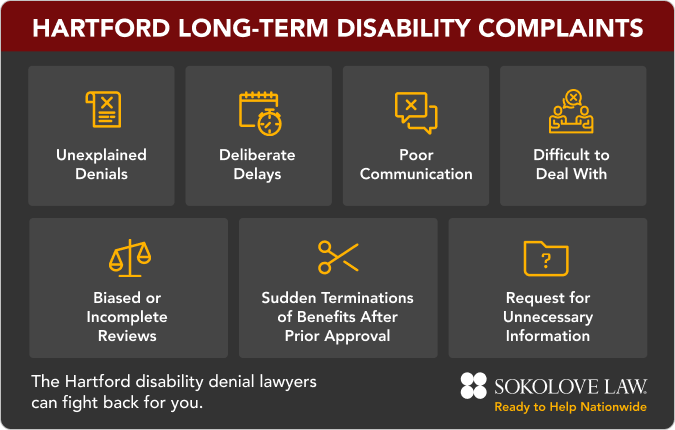
Hartford long-term disability complaints follow a consistent pattern: unexplained denials, repeated requests for the same documentation, and a process that feels designed to exhaust claimants rather than evaluate them.
The most common themes in Hartford disability complaints include:
- Unexplained Denials: Claimants report receiving denial letters with little or no explanation of what evidence was missing or what standard was not met, making it difficult to know what to submit on appeal.
- Deliberate Delays: Multiple reviewers describe Hartford adjusters requesting documentation one piece at a time, extending the review process for weeks or months beyond what ERISA's deadlines require.
- Sudden Terminations after Long Approval Periods: Claimants who had been receiving benefits for years or even decades describe having their claims reopened and ultimately terminated without a meaningful change in their medical condition.
- Poor Communication: Difficulty reaching assigned adjusters, unreturned calls, and inconsistent information across representatives are among the most frequently cited complaints.
One ConsumerAffairs reviewer described submitting documentation by fax, email, and mail while recovering from brain surgery — only to have Hartford claim the paperwork was never received and ultimately deny the claim on that basis.
These experiences mirror what federal courts have described in Hartford ERISA denial lawsuits: A company that, despite their size and resources, has been repeatedly found to have handled individual claims unfairly.
How to Fight a Hartford Disability Denial
When Hartford denies your long-term disability claim, fighting back can feel impossible. Strict deadlines, complex policy language, and an insurance company with a dedicated legal team are a lot to take on when you're not at your best.
That's where having a Hartford disability lawyer from Sokolove Law on your side can make all the difference and potentially improve your chances of recovering the benefits you're owed.
A Hartford disability denial lawyer on our team can:
- Explain the Reason for Your Denial: Your Hartford denial letter explains why the insurer rejected your claim, but these explanations are often technical, vague, or deliberately hard to decipher.
- Gather Additional Evidence to Fill the Gaps: A strong Hartford disability appeal requires updated medical records, detailed physician statements, specialist opinions, and clear documentation of how your condition limits your ability to work.
- File Appeals or a Lawsuit on Your Behalf: Before filing a Hartford disability lawsuit, ERISA requires you to exhaust the internal appeals process. Our attorneys can prepare and submit your appeal or take the next step and file a lawsuit.
- Handle All Communications with Hartford: We manage every interaction, ensuring nothing is said or submitted that could be used against your claim.
Hartford has experienced legal teams ready to defend every denial. They are prepared to spend significant time and resources fighting your claim. You should not have to face that alone.
At Sokolove Law, we can help level the playing field by building a strong case and advocating for the long-term disability benefits you're entitled to. There are no upfront costs to have us manage the process on your behalf.
Hartford Disability Lawsuit News & Updates
Hartford disability lawsuits and legal developments continue to raise serious questions about how the insurer handles claims.
Federal court decisions involving Hartford Life and Accident Insurance Company reveal recurring patterns of paper-only medical reviews, terminations of long-running claims, and tactics that courts have found problematic.
Recent Hartford disability lawsuit updates and legal developments include:
- A Massachusetts federal court found that Hartford abused their discretion when they denied an attorney's long-term disability claim, overriding her treating physician's opinion with a paper-only review (O'Connell v. Hartford Life and Accident Insurance Company, D. Mass. 2023).
- The 2nd Circuit reviewed Hartford's termination of a former HR manager's long-term disability benefits after more than 11 years of continuous payments, highlighting Hartford's pattern of re-examining approved claims (Flowers v. Hartford Life & Accident Ins. Co., 2nd Cir. 2025).
- A Connecticut federal court ruled that Hartford must produce internal claims-handling documents under ERISA's own procedural rules after a physician challenged the denial of her disability benefits (Gannon v. Hartford Life and Accident Ins. Co., D. Conn. Oct. 2025).
- The 2nd Circuit ruled that Hartford cannot use indefinite "further review" letters to delay appeal decisions beyond ERISA's required timeframes, protecting claimants from being kept in legal limbo (McQuillin v. Hartford Life and Accident Insurance Company, 2nd Cir. 2022).
- Hartford Life and Accident Insurance Company was among the defendants in a $13.75 Million class action settlement over a 2023 data breach that exposed the personal information of more than 2.5 million individuals, including names, Social Security numbers, and other sensitive data.
- In a market conduct examination covering 2013 through 2019, the New York Department of Financial Services found that Hartford Life and Accident Insurance Company committed two violations of New York Insurance Law.
- The U.S. Supreme Court ruled unanimously that Hartford's contractual statute of limitations can begin running before a final denial is issued, making prompt legal action after any Hartford denial essential (Heimeshoff v. Hartford Life & Accident Insurance Co., 571 U.S. 99, 2013).
From disputed medical reviews to the termination of benefits paid for over a decade, Hartford disability denials follow patterns that experienced attorneys recognize — and know how to challenge.
Recent lawsuits and regulatory actions continue to raise concerns about how some Hartford disability claims are evaluated, delayed, or denied.
Supreme Court Rules Against Hartford Claimant on Statute of Limitations
The U.S. Supreme Court ruled unanimously that the clock to file a lawsuit against Hartford can begin running before a claimant even receives a final denial, specifically from the date proof of loss was due under the policy and not the date Hartford issued their denial letter.
The case involved a Walmart manager with fibromyalgia, irritable bowel syndrome, and lupus whose Hartford LTD claim was denied and who sued in federal court, only to have her case dismissed because the limitations period had already expired.
The Court held that accrual provisions are enforceable under ERISA as long as they are reasonable. For policyholders today, the ruling highlights the importance of contacting a Hartford disability attorney as soon as possible.
2nd Circuit Blocks Hartford's Indefinite Review Delay Tactic
The 2nd Circuit called out Hartford's tactic of sending a letter to "overturn" a denial and forwarding the file for further internal review, without ever issuing a benefit determination within ERISA's required timeframes.
The court ruled that this approach doesn’t satisfy ERISA's appeal requirements. Without a proper benefit determination issued within the 45-day appeal window or a valid extension notice, claimants are entitled to treat the appeal as denied and proceed directly to federal court, the court explained.
The case involved a 58-year-old sales rep from New York with complications from prostate cancer treatment, including incontinence and fatigue. The decision protects Hartford claimants from being left in indefinite administrative limbo while their deadline to sue quietly expires.
Hartford Wrongfully Denied Attorney's LTD Claim
A Massachusetts federal court found that Hartford unjustly denied an attorney's long-term disability claim for lifelong anxiety worsened by her job responsibilities.
The woman submitted a claim supported by her treating physician. Hartford denied it, relying instead on a paper-only review by a Hartford-retained physician who had never examined her in person, according to the lawsuit.
Her Massachusetts Hartford lawsuit attorneys convinced the court that this approach fell short of the standard required under ERISA and ordered Hartford to reconsider the claim.
Find a Hartford Disability Lawyer Near You
As a national law firm, we have the resources and experience to help individuals facing an unfair Hartford denial, regardless of where they’re located in the United States.
Our Hartford disability lawyers can help families in all 50 states:
- Alabama
- Alaska
- Arizona
- Arkansas
- California
- Colorado
- Connecticut
- Delaware
- Florida
- Georgia
- Hawaii
- Idaho
- Illinois
- Indiana
- Iowa
- Kansas
- Kentucky
- Louisiana
- Maine
- Maryland
- Massachusetts
- Michigan
- Minnesota
- Mississippi
- Missouri
- Montana
- Nebraska
- Nevada
- New Hampshire
- New Jersey
- New Mexico
- New York
- North Carolina
- North Dakota
- Ohio
- Oklahoma
- Oregon
- Pennsylvania
- Rhode Island
- South Carolina
- South Dakota
- Tennessee
- Texas
- Utah
- Vermont
- Virginia
- Washington
- West Virginia
- Wisconsin
- Wyoming
Insurance companies have entire teams working around the clock to protect their profits. You deserve someone fighting just as hard for you and the benefits you’ve paid for. Contact us now to find a Hartford lawyer near you.
Get Help with Your Hartford Disability Benefit Denial
With Sokolove Law on your side, you don't have to feel intimidated by large insurance companies like The Hartford. If you have a case, we can handle the appeals process and every step that follows on your behalf.
Why choose Hartford disability insurance lawyers with Sokolove Law?
- Over 45 years of experience fighting for clients with denied disability claims
- More than $150 Million total recovered on behalf of clients nationwide
- No upfront costs or out-of-pocket fees — we only get paid if you do
Call (800) 995-1212 right now or fill out our contact form for a free, no-obligation legal consultation.
Hartford Long-Term Disability Denied FAQs
Can I appeal a Hartford long-term disability denial?
Yes. If The Hartford unfairly denies your long-term disability claim, you typically have the right to appeal their decision. Many families work with a Hartford disability insurance attorney to help ensure deadlines are met, evidence fills in any gaps, and their appeal is as strong as possible.
However, you only have a limited time to file a Hartford disability insurance appeal, so it's important to reach out to a lawyer without delay. Get started now with a free case review.
How does Hartford Group long-term disability work?
Hartford group long-term disability coverage is meant to provide financial support by replacing part of your income when a serious illness or injury prevents you from doing your job. However, the insurer has been known to wrongfully deny valid claims.
In theory, the process is straightforward:
- A qualifying medical condition leaves you unable to work under the terms of your Hartford policy
- You submit a claim to Hartford along with supporting medical records and proof of employment
- A waiting period must pass, often between 90 and 180 days, before LTD benefits kick in, but Hartford short-term disability may cover this gap
- If approved, you begin receiving benefits, generally equal to about 60% of your earnings before you became disabled
- Those payments continue for a defined period, anywhere from a few years to retirement age, based on the terms of your specific Hartford insurance policy
In practice, it rarely goes that smoothly. Hartford may conduct ongoing reviews of approved claims, which can include requests for updated medical documentation and may result in termination of benefits at any point, even after a claim has been approved for years.
Does Hartford deny long-term disability claims?
Like many disability insurance providers, The Hartford has been the subject of national investigations into the routine wrongful denial of LTD claims.
Their reach in this space is significant: In 2017, The Hartford acquired Aetna's entire U.S. group life and disability business, making them the second-largest group disability insurer in the country.
Aetna had a well-documented history of claim denials, so policyholders once covered under Aetna may now find themselves navigating the same issues under a different name.
If The Hartford denied your claim, our long-term disability denial attorneys may be able to help you appeal their decision. Contact us today to learn more.
How long does Hartford long-term disability last?
The Hartford long-term disability benefits can last anywhere from a few years to until retirement age, depending on the terms of your policy and the nature of your disability.
Many Hartford policies pay benefits:
- For a set period, such as 2, 5, or 10 years
- Until you reach Social Security retirement age
- As long as you continue to meet the policy’s definition of disability
Reviewing your plan documents can help you understand how long benefits may be available under your specific coverage.
Why did Hartford deny my long-term disability claim?
If your long-term disability benefits were denied, The Hartford may have claimed that:
- You failed to disclose a pre-existing health condition
- Your medical examinations were insufficient or inadequate
- There were problems with your paperwork or documentation
- Your medical condition does not qualify as a “covered” disability
- Your procedure was elective, not medically necessary
Our team can explain the reason for your denied Hartford disability claim and fight for the benefits you deserve if the denial was unfair.
What are Hartford long-term disability qualifications?
To qualify for long-term disability benefits, you generally must have a medically documented condition that keeps you from working and satisfies your policy’s definition of disability.
Many Hartford policies start with an "own occupation" standard, meaning you qualify if you can no longer perform the duties of your specific job. But after 24 months, the definition often shifts to "any occupation," meaning Hartford can cut off benefits if they determine you're capable of doing any work.
Eligibility requirements and covered conditions can vary by insurance provider and plan, so reviewing your policy carefully can help you understand what is needed to qualify for coverage.
How do I fight a Hartford claim denial?
If The Hartford denied your LTD claim, it may be in your best interest to get an opinion from a long-term disability denial attorney for help challenging their decision and potentially recovering your benefits.
With experienced legal help on your side, you can focus on your health and recovery, while we focus on the appeals process.
Can I file a Hartford disability lawsuit over a denied claim?
Potentially, yes. If The Hartford denied your long-term disability claim and you’ve already gone through the appeals process, you may be eligible to file a lawsuit against Hartford for disability denial.
Only an attorney can determine if this is possible in these situations. Find out if you’re eligible now by calling (800) 995-1212 or filling out our contact form.
How much does a Hartford LTD disability lawyer cost?
At Sokolove Law, our Hartford long-term disability lawyers work on a contingency-fee basis, which means there are no upfront or out-of-pocket fees. We only get paid if your case results in compensation.
When does Hartford pay short-term disability?
The Hartford short-term disability benefits typically begin after your claim is approved and any elimination period has passed.
Once approved, payments are usually issued weekly or biweekly. However, the exact timing can vary based on:
- Your employer’s disability plan
- How quickly medical records are submitted
- Whether additional information is needed
- The terms of your specific policy
Many claimants receive an initial decision within a few weeks, but delays can happen if paperwork is incomplete or if The Hartford requests more medical evidence.
