Dying from Mesothelioma: What to Expect
A mesothelioma diagnosis can be overwhelming and lead to many questions. One of the most common and difficult questions that victims and their families ask is, “How does mesothelioma kill you?”
In the later stages of this disease, tumors can spread beyond their original location and begin to interfere with the operation of vital organs, like the heart, kidneys, liver, or lungs.
Patients dying from mesothelioma may experience:
- Abdominal swelling from fluid buildup (ascites)
- Confusion or cognitive changes as oxygen levels fall
- Difficulty swallowing or eating as tumors press on the esophagus
- Increasing chest pain or abdominal pain
- Reduced heart and lung function
- Severe fatigue and significant weight loss
- Worsening shortness of breath as fluid builds around the lungs or the lungs themselves are compressed by tumor growth
These late-stage mesothelioma symptoms are often compounded by serious complications, including a weakened immune system that may increase the risk of potentially fatal infections.
“The most common causes of death are respiratory failure or pneumonia. In about 1 of every 3 patients, a small bowel obstruction develops as a result of tumor that has spread to the abdomen. About 1 in 10 patients die of cardiac complications when the tumor invades the pericardium and the heart.”
– Baylor Medicine
Understanding how mesothelioma progresses may help you prepare physically and mentally for the potential outcomes. Patients diagnosed with mesothelioma are often eligible for financial compensation.
This compensation can help patients access the best treatment options to ease their symptoms and improve their quality of life, even in late-stage mesothelioma. See if you can pursue compensation now.
Since 1979, Sokolove Law has secured over $5.5 Billion for thousands of mesothelioma victims and their families.
Contact Us Now
 John & Dee Sokolove Law Clients
Why Is Mesothelioma So Deadly?
Mesothelioma is often considered an aggressive and deadly cancer largely because of when it's found. Symptoms can take 20-50 years to develop after asbestos exposure, and the disease is often considered advanced by the time an accurate diagnosis is made.
Several factors contribute to why mesothelioma is so deadly:
- Decades of damage: Asbestos fibers can irritate and scar the delicate lining of the lungs, abdomen, heart, or testes for decades before a diagnosis is made, causing irreversible damage.
- Late-stage diagnoses: Nearly half of all mesothelioma patients are diagnosed at stage 4, according to a review of the National Cancer Database. At this point, treatment options may be limited.
- Patients are older: Because of this cancer’s long latency period, the average age at diagnosis is 72, according to the American Cancer Society. As a result, patients may not be able to withstand the most aggressive treatments.
That said, mesothelioma is not always fatal. Advances in research and treatment options have allowed some patients to live for years beyond their initial prognoses.
How Do People with Mesothelioma Die?
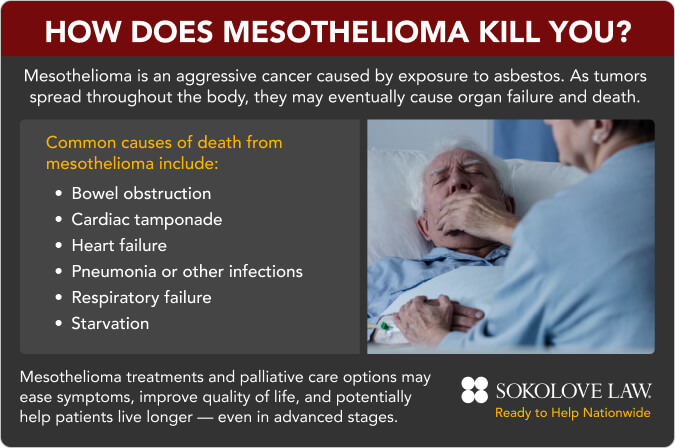
Mesothelioma is a fast-growing cancer that typically leads to death by damaging the lungs or abdominal organs. As tumors spread, they interfere with critical body functions, often resulting in respiratory failure, infections, or impaired nutrient absorption.
In many cases, the disease makes it increasingly difficult to breathe. Tumor growth and fluid buildup around the lungs can restrict lung expansion, reducing oxygen levels and placing significant strain on the body.
How mesothelioma kills typically depends on where the cancer originated. Each type of mesothelioma tends to follow its own progression and path toward death.
Dying from Pleural Mesothelioma
Pleural mesothelioma forms in the lining of the lung. When it advances, tumors spread across the lungs and chest wall, causing a buildup of fluid and making breathing increasingly difficult.
As the disease progresses, this fluid accumulates faster than it can be drained, and the lungs lose more and more of their functional capacity. In the final stages, patients are often unable to take in enough oxygen to sustain basic bodily functions, and respiratory failure sets in.
Pneumonia and other infections can accelerate the process of dying from pleural mesothelioma, as well as complications from surgery, according to the National Library of Medicine.
Dying from Peritoneal Mesothelioma
Peritoneal mesothelioma forms in the lining of the abdomen and tends to spread across the abdominal cavity. As this happens, the digestive system can become increasingly compromised.
In the final stages of peritoneal mesothelioma, patients often die from intestinal obstructions or starvation, according to the World Journal of Gastrointestinal Surgery. When tumors encase the bowel completely, the body loses its ability to absorb nutrients or pass waste.
Even with food intake or nutritional support, the digestive system can no longer function properly, resulting in malnutrition, dehydration, and weight loss. This may be compounded by severe muscle wasting known as cachexia, which further weakens the body.
Dying from Pericardial Mesothelioma
Pericardial mesothelioma is a rare form of this cancer that originates in the lining of the heart, known as the pericardium. As tumors grow and fluid accumulates around the heart, the organ comes under increasing pressure and eventually loses its ability to pump blood effectively.
The most common causes of death from pericardial mesothelioma include:
- Cardiac tamponade, which occurs when fluid builds up in the pericardial sac so rapidly that the heart becomes compressed and can no longer fill or pump properly
- Congestive heart failure, which develops as tumors invade and stiffen the heart's surrounding tissue, forcing the heart to work harder until it can no longer pump enough blood to meet the body's needs
- Vena cava occlusion, which happens when tumor growth blocks the large vein that returns blood to the heart and cuts off circulation
Around 70% of pericardial mesothelioma tumors are diagnosed postmortem, meaning many patients die before a diagnosis is ever made, according to Case Reports in Medicine.
Dying from Testicular Mesothelioma
Testicular mesothelioma originates in the lining of the testes and tends to have a better prognosis than other types. Most patients present with fluid around the testicle (a hydrocele) or a painless testicular mass, often leading to an earlier diagnosis.
When testicular mesothelioma does become fatal, it’s typically because the cancer has spread beyond its original site. Metastasis in testicular mesothelioma occurs most commonly through the lymphatic system and often involves the liver and lungs, according to Autopsy Case Reports.
Once the cancer reaches those organs, testicular mesothelioma progression tends to follow a path similar to peritoneal or pleural mesothelioma, with organ function deteriorating as more tumors form.
How Long Does Mesothelioma Take to Kill?
The life expectancy for mesothelioma patients who receive some form of treatment is 12 to 21 months after diagnosis, according to Frontiers in Oncology. Without treatment, the median survival time is approximately 7 months.
However, this number can vary widely based on many factors, including the type of mesothelioma, the cancer’s stage at the time of diagnosis, a patient’s age, and which treatment options may be available to them:
- Pleural mesothelioma patients who undergo surgery combined with chemotherapy have an average survival time of 32 months, according to the Journal of Thoracic Disease.
- Peritoneal mesothelioma patients treated with surgery and heated chemotherapy (HIPEC) have an average survival time of 53 months, according to Cancer Management and Research.
- Patients with pericardial mesothelioma have a median overall survival of just 6 months, but those who received platinum-based chemotherapy have a median survival rate of 13 months, per the journal Clinical Lung Cancer.
- Patients with localized testicular mesothelioma survive approximately 56 months on average, while those with advanced disease at diagnosis survive around 23 months, according to Memorial Sloan Kettering.
Every mesothelioma case is unique, and a doctor can help you better understand your potential life expectancy and how to fight this cancer. Some patients have survived for years or even decades after a diagnosis.
Chances of Dying from Mesothelioma
The overall 5-year survival rate for pleural mesothelioma is approximately 15%, according to the American Cancer Society. This means that the majority of mesothelioma patients don’t survive 5 years past their diagnosis.
For patients diagnosed with stage 4 mesothelioma, which is the most advanced stage of this cancer, the 5-year survival rate drops closer to 11%.
However, survival statistics don't account for many important factors:
- Age: Patients who are younger and in good overall health at the time of diagnosis tend to fare better, as their bodies can tolerate more aggressive treatment. Patients diagnosed before age 50 have notably higher 5-year survival rates than those diagnosed later in life, according to Moffitt Cancer Center.
- Cancer stage: Most patients are diagnosed at stage 3 or 4, when the cancer has already spread and surgery is no longer an option. However, those diagnosed at an earlier stage may have access to a wider range of treatment options, which can significantly extend survival.
- Cell type: Not all mesothelioma cells behave the same way. Epithelioid cells grow more slowly and respond better to treatment, giving patients a longer life expectancy. Sarcomatoid cells, by contrast, spread aggressively and are largely resistant to treatment.
- Sex: Women tend to outlive men after a mesothelioma diagnosis. One study found that women with pleural mesothelioma have a 5-year survival rate of 13.4%, versus just 4.5% in men, according to the Annals of Thoracic Surgery.
- Type of mesothelioma: Where the cancer originates has a major impact on survival. Patients with peritoneal and testicular mesothelioma tend to have a longer life expectancy than patients with pleural or pericardial mesothelioma.
The chances of dying from mesothelioma depend heavily on circumstances that vary from patient to patient — and for some, outcomes look very different from what the averages suggest.
At Sokolove Law, we’ve helped over 9,500 asbestos exposure victims access financial assistance for treatment and other expenses. Call (800) 647-3434 now to see if you may be eligible.

“I'm doing very well now, as a matter of fact. I play golf twice a week. I ride the side-by-side. I go hang out with my friends when they're around. Yeah, I'm pretty well back to normal.”
– John, 6+ Year Pleural Mesothelioma Survivor & Firm Client
Signs of Dying from Mesothelioma: End or Final Stage Symptoms
In the early stages, mesothelioma symptoms may present as a cough or shortness of breath. However, once the cancer begins to progress, symptoms become more serious. Cancer cells will also spread to other areas within the body, causing additional complications.
In their final days, a mesothelioma patient’s body may begin to shut down, causing them to sleep for most of the day, eat and drink very little, and drift in and out of consciousness. Breathing may also become irregular or labored, and periods of restlessness or confusion are common.
Late or end-stage mesothelioma symptoms can include:
- Abdominal and lower back pain
- Digestion issues
- Fatigue
- Fluid buildup in the chest
- Growing pain and tightness in the chest
- Persistent cough, sometimes resulting in coughing up blood
- Swelling in various parts of the body, including the abdomen, face, and neck (if spread to lymph nodes)
Because mesothelioma can spread to the lymph nodes, which help the immune system filter toxins and fight infections, many patients in the later stages also experience a significantly weakened immune system, increasing the risk of serious infections at the end of life.
Recognizing the signs of dying from mesothelioma can help patients and families prepare for what lies ahead and ensure that comfort and care remain the priority.
Is Mesothelioma a Painful Death?
For many patients, mesothelioma can cause significant pain toward the end of their lives. As tumors press against nerves, organs, and surrounding tissue, pain typically intensifies — and in the final stages, it can become the dominant feature of the disease, according to Seminars in Thoracic and Cardiovascular Surgery.
Fluid buildup in the lungs or abdomen can also add additional pressure on surrounding structures, compounding that discomfort.
However, mesothelioma pain doesn’t have to go untreated. Palliative or pain-relieving care is often prioritized in order to address this discomfort, which may include pain medications and procedures to drain excess fluid.
Palliative Care Aims to Make Patients Comfortable
Mesothelioma palliative care focuses on relieving symptoms and improving quality of life through measures like pain management, oxygen for breathing, draining fluid buildup, and emotional support — rather than trying to cure the disease.
One common misconception is that palliative care for mesothelioma is reserved for the final weeks of life. In reality, it can begin at the time of diagnosis, running alongside active treatment.
Palliative care options for mesothelioma may include:
- Opioid pain management
- Procedures to drain fluid from the lungs or abdomen to relieve pressure
- Radiation therapy to shrink tumors and reduce localized pain
- Surgical procedures like a cordotomy, which interrupts specific pain-transmitting nerve fibers in the spinal cord
Mental health support is also a core component of palliative care. This may involve counseling for anxiety and depression or joining a support group to connect with other mesothelioma patients.
Palliative care can be costly, but mesothelioma patients may be entitled to compensation from the asbestos-related companies responsible for their exposure. Many of our clients begin receiving compensation within 90 days of contacting us.
Since 1979, Sokolove Law has secured more than $5.5 Billion for thousands of mesothelioma victims and their families.
Get a Free Case Review
How Many People Die Each Year from Mesothelioma?
Approximately 38,400 people die from mesothelioma each year, according to the World Health Organization’s Mortality Database. In the United States, around 2,200 Americans pass away from mesothelioma annually.
In 2023, the Centers for Disease Control and Prevention (CDC) reported 2,127 mesothelioma cancer deaths across all 50 states, down 28.6% since 2013.
The decline in mesothelioma deaths likely reflects decades of reduced asbestos use in American workplaces. However, many asbestos victims who were exposed decades ago may still be at risk of getting sick today.
How Many People Have Died from Mesothelioma?
While the exact number of people who have died from mesothelioma is unknown, the total human cost of this cancer is staggering. Mesothelioma was first formally tracked by the World Health Organization in 1994, and in the 15 years that followed, an estimated 174,300 deaths were recorded across 56 countries.
Researchers note that the true toll is likely higher, as many countries lack the infrastructure to accurately track and report mesothelioma deaths.
What makes these deaths particularly devastating is that they were preventable. Many companies knew asbestos was dangerous, but they continued to use it in products sold to the U.S. military, construction materials, and factory settings to increase profits — without warning workers or the public about the risks.
Is Mesothelioma a Death Sentence?
Mesothelioma is generally considered a terminal cancer, but it’s not necessarily a death sentence. Some patients have gone on to live for years or even decades after their diagnosis.
Seeking an early diagnosis and pursuing specialized mesothelioma treatment can improve patient outcomes. In recent years, advances in treatment options like immunotherapy have also improved survival rates for patients, including a landmark clinical trial involving nivolumab and ipilimumab.

"So many people go on Dr. Google, and there's a lot of misinformation and information that doesn't apply to that particular individual. They tend to look at the worst — but I tell them this is not a guaranteed death sentence.”
– Dr. Raja Flores, Mesothelioma Specialist
At Moffitt Cancer Center, one of the nation's leading mesothelioma treatment centers, the overall 5-year survival rate is 17.3% for advanced mesothelioma — a figure that reflects what's possible when patients receive specialized care tailored to their unique circumstances.
Get Compensation for Mesothelioma Wrongful Deaths
If your loved one has already passed away from mesothelioma, we may be able to help your family secure justice and compensation from an asbestos claim after their death. This money can help with outstanding medical bills, funeral and burial expenses, lost wages, and more.
When filing a mesothelioma lawsuit, compensation for family members ranges from $1 Million to $11.4 Million on average, depending on whether the case settles or goes to court.
At Sokolove Law, we understand that no amount of money can replace the person you lost. However, holding the at-fault companies accountable and securing your family’s financial future is one of the most meaningful steps you can take in their honor.
Fighting for Mesothelioma Survivors & Surviving Families
As a national asbestos law firm, Sokolove Law has spent over 45 years helping survivors and families across the country seek justice after a mesothelioma diagnosis.
To date, we’ve secured more than $5.5 Billion for mesothelioma patients and their loved ones.
There are no upfront costs or hourly fees to work with our asbestos attorneys. We only get paid if you do, so there’s no financial risk to taking legal action.
Call (800) 647-3434 now or fill out our contact form to get started with a free case review. Our team is standing by to answer any questions you may have.
Dying from Mesothelioma FAQs
Can you die from mesothelioma?
Mesothelioma is generally considered a fatal disease, especially when diagnosed at an advanced stage. Roughly 85% of pleural patients pass away within 5 years of their diagnosis, according to the American Cancer Society.
However, some patients have gone on to live for years or even decades after their initial diagnosis. Patient outcomes depend heavily on the type and stage of mesothelioma at the time of diagnosis, the patient's overall health, and whether they receive treatment from specialists experienced with this rare cancer.
How deadly is mesothelioma?
The majority of mesothelioma patients pass away from this cancer, with an overall 5-year survival rate of approximately 12%, according to the National Cancer Institute.
However, mesothelioma isn’t always fatal, and survival rates have been steadily improving thanks to advances in research and treatments. New approaches, including immunotherapy, targeted therapies, and multimodal treatment plans, are helping some patients live longer than ever before.
How do people with mesothelioma die?
In the end stages of mesothelioma, patients typically die as a result of the cancer spreading throughout the body and interfering with vital organ function, causing them to fail.
In some cases, a weakened immune system also leaves patients vulnerable to infections like pneumonia that can become independently fatal.
The specific cause of death varies by mesothelioma type:
- Pleural mesothelioma: Respiratory failure and pneumonia are the most common causes of death, as tumors and fluid buildup in the chest compress the lungs and progressively reduce the patient's ability to breathe, according to Baylor Medicine.
- Peritoneal mesothelioma: Patients may die from complications linked to bowel obstruction, severe malnutrition, or the body's inability to absorb nutrients as tumors invade the abdominal organs.
- Pericardial mesothelioma: Patients may pass away from cardiac complications such as congestive heart failure, as tumors interfere with the heart's ability to pump blood effectively.
- Testicular mesothelioma: When testicular mesothelioma reaches its advanced stages, the cancer can metastasize to the lymph nodes, brain, lungs, and beyond, ultimately overwhelming the body and causing organ failure.
Compensation may be available to help mesothelioma patients pay for treatments that could potentially extend their life expectancy and improve their quality of life. Contact Sokolove Law now to see if you qualify.
How long does mesothelioma take to kill?
Mesothelioma takes decades to develop after asbestos exposure, but the cancer typically progresses quickly once symptoms appear. The average life expectancy after diagnosis is 12-21 months for patients who undergo treatment, according to Frontiers in Oncology.
Patient outcomes vary significantly based on a patient’s cancer type and stage, as well as their overall health. Treatment can significantly extend a patient’s life expectancy and may allow some patients to become long-term survivors.
Have there been any famous deaths caused by mesothelioma?
Yes. Mesothelioma doesn’t discriminate by fame or fortune, and a number of well-known public figures have lost their lives to this disease.
Well-known figures who have died from mesothelioma include:
- Steve McQueen, legendary actor and military veteran
- Leonard Bernstein, a composer
- Merlin Olsen, a professional football player
- Quincy Jones, a stand-up comedian
- Ron Cyrus, a politician
- Warren Zevon, a singer and songwriter
Throughout much of the 20th century, countless industries relied on asbestos-containing products, putting anyone who came in contact with these products at risk of developing mesothelioma.
What is dying from mesothelioma like?
Dying from mesothelioma typically involves worsening physical symptoms as the cancer advances. Patients often experience worsening shortness of breath, persistent chest or abdominal pain, fatigue, and significant weight loss. These symptoms may intensify as tumors grow and spread to surrounding organs.
In the final weeks and days of life, the body begins to shut down, and patients may sleep for most of the day. They may refuse to eat or drink and experience periods of restlessness or confusion.
Palliative and hospice care teams play a crucial role during this time, managing pain and discomfort, so the final stage of life is as peaceful as possible.
Is death from mesothelioma painful?
For many patients, mesothelioma does cause significant pain, particularly as fluid builds up or tumors grow and begin to press against nerves, organs, and surrounding tissue. Palliative care focuses specifically on symptom relief, offering a range of options to manage pain from medication to minor procedures to drain fluid.
At Sokolove Law, we can help patients understand their treatment options and secure compensation for care. Call (800) 647-3434 now to speak with our team.
What are signs of dying from mesothelioma?
While each mesothelioma patient’s experience is different, there are several common signs that may indicate the end of life is approaching, including extreme fatigue, severe shortness of breath, confusion or reduced alertness, and loss of appetite or difficulty eating.
As the disease progresses, these symptoms often intensify, and patients may become less responsive or aware of their surroundings. In many cases, care shifts toward comfort-focused measures, like pain management and breathing support, to help maintain quality of life in the final days or weeks.
Can families file wrongful death claims for mesothelioma?
Yes. If your family member passed away from mesothelioma, you may be able to file a wrongful death claim against the asbestos-related companies responsible for their illness.
These claims are often filed by a victim’s spouse, sibling, child, or estate representative, helping to recover compensation for medical bills, funeral expenses, lost income, emotional suffering, and more.
What is the average wrongful death settlement for mesothelioma?
The average wrongful death settlement for mesothelioma ranges from $1 Million to $1.4 Million, though results vary based on the individual facts of each case. Compensation may be awarded for funeral expenses, outstanding medical bills, lost wages, and more.
At Sokolove Law, over 99% of our mesothelioma lawsuits settle, meaning many of our clients receive compensation without ever having to set foot in court. To date, we’ve secured over $5.5 Billion for families impacted by mesothelioma.
Find out if you may be able to pursue compensation from a mesothelioma wrongful death settlement. Get a free case review now.
Can you survive mesothelioma?
Yes. While mesothelioma is a serious and often terminal diagnosis, long-term survival is possible — especially with early detection and treatment from a mesothelioma specialist. Roughly 1 in 7 patients are still alive 5 years after their diagnosis, according to the American Cancer Society.
Paul Kraus, for example, was diagnosed with mesothelioma in 1997 and survived for nearly 30 years before passing away from an unrelated cause.
Mesothelioma survivor stories offer hope, showing that while the disease is challenging, outcomes are not always predictable. Some of the patients we’ve supported have gone on to live for years past their doctor’s initial prognosis.